Category: Equity & Social Justice

Centering anti-oppression, anti-racism, and decolonization in doula practice. Learn from Indigenous birth work, truth and reconciliation, intersectionality, and equity-driven approaches to care.

  • Trans Day of Remembrance

    Trans Day of Remembrance

    [vc_row][vc_column][vc_column_text css=”.vc_custom_1700318432768{margin-bottom: 0px !important;}”]Trans people’s existence is not an ideology. Transness is a natural and inevitable aspect of the wondrous biological and social diversity of human beings. As humans engage in a debate about whether or not some humans get to use bathrooms, attend school safely, and read stories to children, much of the panic regarding “gender ideology” is fueled by myths and misinformation that appear to have taken off like the wildfires that plagued us this Spring and Summer. 

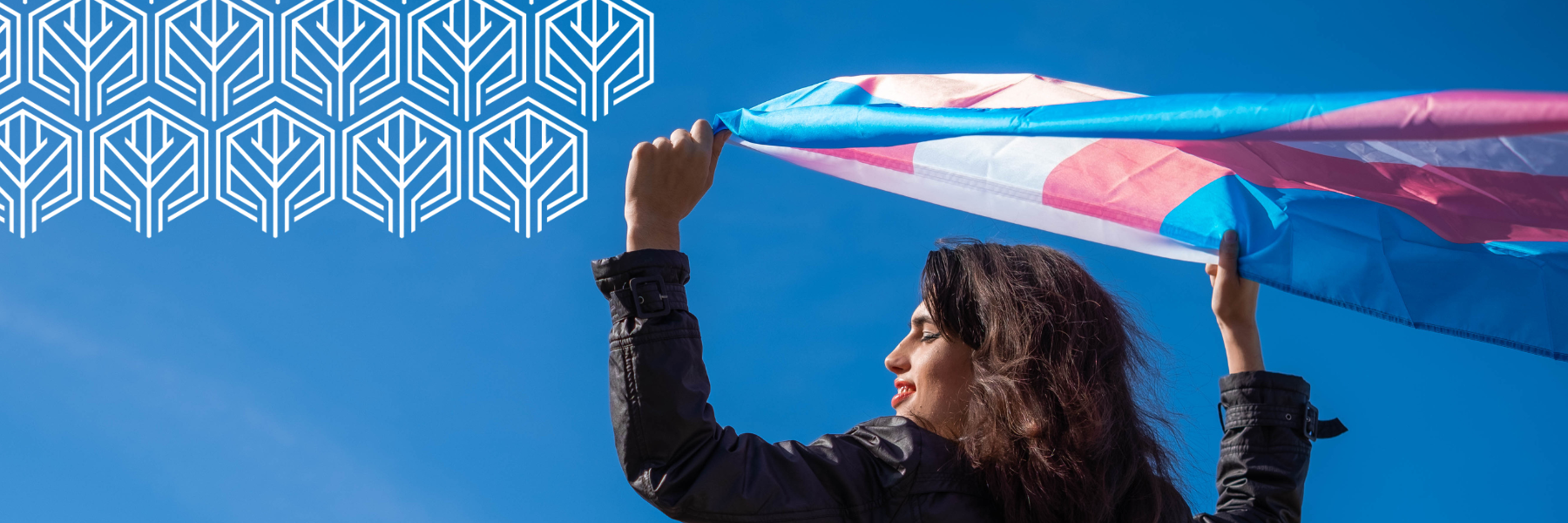
    Like wildfire, these myths are dangerous because they kill. Trans youth are at 7.9 times the risk of attempting suicide and 4 times more likely to be the victims of violent crime than their cis counterparts. Those who lose their lives to violence continue to be overwhelmingly trans, Black women. That’s why November 20 is Trans Day of Remembrance.

    Here are some of the most toxic myths fanning the flames of fear and hate, followed by the facts that can douse those flames.

    Myth 1: People come in two kinds, male and female. 

    Fact: There is ample scientific evidence that human biology is far more complex than inny equals girl, outie equals boy. 

    MRI-based studies show that the putamen (the region of the brain that controls cognitive functioning and other tasks) in trans people differs from structural norms that are consistent with their assigned gender and more closely resembles their felt gender. (Flint et. al. 2020; Clemens et. al. 2021)

    Epigenetics is the emerging science regarding how different genes in our biological makeup get switched on and manifest. This epigenetic study found that since all human embryos start with the potential to be male or female, hormonal variation during sex differentiation can cause genetic changes that cause a person’s gender to be different from their sex.   

    I’m a science junkie and I could go on with articles about hormone receptor mutations and genetic perspectives. But I think you get the idea that the biology of transness is a lot more complicated than the primer we got in grade school.

    Myth 2: People who think their gender is different from their biological sex are mentally ill.

    Fact: Well, technically being trans is a mental illness. The 5th edition of the Diagnostics and Statistics Manual (DSM-V), a compendium that provides diagnostic criteria for all mental illnesses, refers to transness as “gender dysphoria”. There is consensus among the mental health professionals that write the DSM that the appropriate treatment is supporting the person to live as their felt gender. Receiving a diagnosis and treatment for gender dysphoria is an involved process. It takes years to be approved for interventions like surgery. People under the age of 16 cannot receive permanent interventions like surgery. As the emerging biological science suggests, the classification of “gender dsyphoria” as a mental illness is controversial in trans communities. For now, people have to meet the diagnostic criteria in the DSM-V to receiving gender-affirming healthcare.

    Myth 3: Trans people are emerging because of the new “gender ideology”.

    Fact: While some of the terminology being used is relatively new, people whose gender experience differs from biological “norms” have always existed. Research shows that over 150 Indigenous nations on Turtle Island recognized a third gender before colonization. Indigenous communities were by no means unique. For example, hijras in South Asia have been recognized as a gender group dating back to the 1200s. Similarly, in pre-colonial Uganda, there was the mudoko dako.

    Myth 4: Talking about trans people in schools “sexualizes children” and “grooms them” into becoming trans.

    Fact: As the facts above demonstrate, trans people have always been here. People are born trans as a result of complex biological factors. The kind of experience they have is determined by society’s attitude toward them. In the pre-colonial societies I mentioned above, trans people were honored and respected members of their communities leading secure and productive lives. Talking about trans people will not make more of them magically appear. Explaining sexual and gender diversity to kids is no more inherently sexual than explaining heterosexual marriage. Failing to talk about LGBTQ+ people won’t make them go away. However, silence will make people more unsafe.

    It’s fitting that November 20 is also National Child Day. The goal of the day is to open dialogue about the vulnerability of children and what we can do collectively to keep them safe and honour their rights. Telling kids the truth is how we can keep them safe. Treating all people with dignity and respect is how we create environments where kids feel safe to be themselves. Arming kids with the language to talk about their bodies and experiences is how we keep them safe from actual groomers. Building up their confidence and self-respect is how we keep trans kids alive and well.


    Keira Grant (she/her) Inclusion and Engagement Lead – Racialized Communities

    Keira brings a wealth of experience to the Online Community Moderator role. She is a Queer, Black woman with a twenty-year track record in Equity, Diversity, and Inclusion (EDI) education, projects, and community building initiatives.

    [/vc_column_text][/vc_column][/vc_row]
  • Domestic Violence Awareness Month

    Domestic Violence Awareness Month

    [vc_row][vc_column][vc_column_text css=”.vc_custom_1698759996931{margin-bottom: 0px !important;}”]Let Clients Know You are a Safe Person to Disclose to about Intimate Partner Violence

    For one-quarter of women who experience DFV [Domestic and family violence], the violence begins during pregnancy. Where violence was previously occurring, it escalates in frequency and severity during pregnancy and early motherhood.” (Baird et. al., 2021)

    Based on this disturbing truth, Baird and many other researchers recommend that all pregnant women be screened for intimate partner and domestic violence. There is a fair amount of controversy and debate within international healthcare systems and among individual providers regarding whether or not to implement this recommendation. 

    Unfortunately, vulnerable pregnant people and children are caught in the middle of that debate. In Sault. Ste. Marie on Oct 24, 2023, 5 people including 3 children were killed due to domestic violence, renewing calls for intimate partner violence to be declared an epidemic.

    We can avoid getting bogged down by debate and discomfort and put the well-being of birthers and families first by being a safe zone for clients to disclose IPV and other trauma. Here are some strategies I’ve used universally to let clients know they can tell me about domestic abuse. I can’t go into details for obvious reasons, but suffice it to say, these strategies work.

    I’d love to hear from you in the comments about what you’re doing to support clients to open up about abuse and violence.

    Create a Cone of Silence

    When couples retain my services, my welcome email explains how each individual can communicate with me confidentially. The email is clearly a template, so it’s obvious that I’m not putting that out there for personal reasons. 

    Then I initiate a chat with the birther via a communication channel that is obviously exclusive to them and me, usually a chat with a cell phone number that I know is theirs. This strategy isn’t perfect since many abusive partners closely monitor the victim’s communication channels. Still, including this in the welcome email normalizes situations where information should not be shared between partners.

    Ask Everyone About Stressors

    I ask clients to complete my intake questionnaire individually rather than as a team. The questionnaire invites the client to share about stressors in their home environment. I’m aware that not everyone might answer a question as blunt as “Are you being abused by your partner?” candidly, especially with someone they are still getting to know. Additionally, abuse can take many shapes and often goes unrecognized. Clients disclose a range of domestic issues in response to this question. Even if nothing is shared at that time, it sends a clear message that I am open to talking about practical, social, and emotional aspects of their pregnancy journey.

    Leverage One-on-One Moments

    Some things come out much more easily face-to-face than they do in other ways. Unfortunately, our work prenatally and postpartum often occurs while both members of a couple are present. I take advantage of times when the birther and I happen to be one-on-one to initiate conversations about the birth and postpartum life. I let all of my birthers know that while I’m here to support them as a team, the buck stops with them. If I have to make a choice, I’m ride or die for the birther. 

    Have Resources at the Ready if Someone Discloses Abuse 

    However the birther decides to handle the situation, I make sure I know about local resources that can support them in that choice. This encompasses therapists, organizations that support women to develop safety and escape plans, community legal clinics, and food security resources. 


    For folks in Ontario, contacting the Assaulted Women’s Help Line is a great way to start figuring out your options to address intimate partner violence. 1.866.863.0511

    [/vc_column_text][/vc_column][/vc_row][vc_row][vc_column][vc_column_text css=”.vc_custom_1698759879666{margin-bottom: 0px !important;}”]Keira Grant (she/her) Inclusion and Engagement Lead – Racialized Communities

    Keira brings a wealth of experience to the Online Community Moderator role. She is a Queer, Black woman with a twenty-year track record in Equity, Diversity, and Inclusion (EDI) education, projects, and community building initiatives.[/vc_column_text][/vc_column][/vc_row][vc_row][vc_column][vc_single_image image=”520952″][/vc_column][/vc_row]

  • International Day for the Eradication of Poverty

    International Day for the Eradication of Poverty

    [vc_row][vc_column][vc_column_text css=”.vc_custom_1698093869318{margin-bottom: 0px !important;}”]The rising cost of food and collective grocery store anxiety rest on a bed of other precarious conditions. The price of everything has gone up. We are still seeing empty shelves in stores “post” pandemic as we head to the mall in shorts on a 33-degree October day. There are numerous causes for feeling uncertainty.

    When society gets taken for a ride, children come right along with us. As someone who works with babies and families, on International Day for the Eradication of Poverty I’m reflecting on the fact that 50% of the world’s children are affected by poverty

    Most of these children are not where I am sitting, in a high-cost-of-living, high-standard-of-living urban centre in Canada. However, people where I am are still afraid of not having enough, and it’s making many people afraid to start a family.

    These fears are justified. Raising children is expensive, and we are facing a food crisis, a housing crisis, a climate crisis, and a healthcare crisis. People and families live in a lot of isolation which makes feeling secure challenging. Poverty has a significantly adverse impact on outcomes during pregnancy and childbirth, and on how all aspects of your life go from there.

    Support from a doula reduces the risk of many of the adverse outcomes that poverty increases the risk of. Sadly, individuals who can benefit the most from improved outcomes are those who are least able to pay the cost of hiring a doula. 

    Doulas and birth workers are a compassionate bunch. No one in this profession is here to get rich, and we want to provide our services to people who can benefit from them the most. However, we also have ourselves and our families to care for, and doing this work well takes time. Far too many kind-hearted people who have trained long and hard and love this work leave after a few years, turning to less rewarding work that pays the bills. When this happens, the doula’s skills go to waste and their community loses out on the transformative care they could have received.

    Advocates within the doula sphere are exploring options to improve community access to doula support while making a long-term career in this field more sustainable. At Doula Canada, we are doing our part by developing a briefing note that will elucidate opportunities and challenges in the current perinatal care landscape, the potential for doulas and childbirth educators to leverage these opportunities and solve these challenges, and models whereby doula care could be cost-effectively funded by a mix of social partners including different levels of government, insurance companies, and foundations. This initiative is directed by the Advocacy Working Group, comprised of Doula Canada members and staff. The Advocacy Working Group is part of our commitment to manifest a culture of equity, diversity, and inclusion (EDI) action within our school. Stay tuned for more on the Doula Access Initiative in the coming months.

    To connect with the Advocacy Working Group at Doula Canada, email Keira Grant, EDI Co-Lead at keira@stefanie-techops.wisdmlabs.net.


    Keira Grant (she/her) Inclusion and Engagement Lead – Racialized Communities

    Keira brings a wealth of experience to the Online Community Moderator role. She is a Queer, Black woman with a twenty-year track record in Equity, Diversity, and Inclusion (EDI) education, projects, and community building initiatives.

     [/vc_column_text][/vc_column][/vc_row]
  • World Food Day

    World Food Day

    [vc_row][vc_column][vc_column_text css=”.vc_custom_1697463575735{margin-bottom: 0px !important;}”]World Food Day hits a little differently this year. The skyrocketing cost of food has driven the federal government to summon the CEOs of Canada’s largest food retailers to a meeting in Ottawa on Thanksgiving Monday.

    Access to food is not just about the rising price of groceries in contrast to incomes that haven’t changed much. This year’s theme for World Food Day is Water is Life. Water is Food. Leave No One Behind. It calls us to reflect on access to food on a deeper level. The Food and Agriculture Organization of the United States notes that 71% of the planet is water, however only 2.5% of that water is fresh, drinkable water.

    Canadians are blessed to live in a freshwater-rich country, however, 28 Indigenous Reservations across the country are still living with long-term boil water advisories. These communities have been systemically left behind, demonstrating that social policies and political will are central dimensions of ending hunger.

    The statement “Water is Food” has an additional layer of meaning for birth workers. Water is the main ingredient in human milk, the ideal first food for all of us. When lactating parents don’t have access to clean drinking water babies are also left behind. When we view food and water as commodities we create a precarious circumstance for society’s most vulnerable members. 

    As victims of the Nestle infant formula scandal learned in the most horrific way possible, diluting formula with contaminated water can mean death for babies. In addition to the health risks associated with formula feeding, the cost of infant formula has risen along with all other goods. This follows on the heels of a formula shortage that saw the price for one canister exceeding $70 in the Territories in 2022 according to one of our members

    When we encourage and champion new parents to normalize, initiate, and sustain lactation and direct breast/chestfeeding we are engaging in a vital action to ensure food security in our communities. When we connect lactation support to action to achieve clean drinking water, and sustainable food networks for all, we are recognizing the intrinsic interconnectedness of social systems and family well-being.

    You can learn more about the struggle to secure clean drinking water for all First Nations in Canada at First Nations Drinking Water Settlement. To learn more about how you can support Indigenous land and water defenders in Canada visit Indigenous Climate Action.


    Keira Grant (she/her) Inclusion and Engagement Lead – Racialized Communities

    Keira brings a wealth of experience to the Online Community Moderator role. She is a Queer, Black woman with a twenty-year track record in Equity, Diversity, and Inclusion (EDI) education, projects, and community building initiatives.[/vc_column_text][/vc_column][/vc_row]

  • Women’s History Month

    Women’s History Month

    [vc_row][vc_column][vc_column_text css=”.vc_custom_1696691842834{margin-bottom: 0px !important;}”]For much of human history and in a myriad of cultures, the ability to create life was revered and seen as a source of power. When Rachel from friends, overdue with Emma famously says “No uterus, no opinion” – she’s describing an attitude that used to be a given. Things started to change in the mid-19th century as the then-exclusively male profession of medicine and the burgeoning specialty of gynecology gained legitimacy and brought reproductive health under its control.

    When you control the uterus, you quite literally control the social order. You assume control of the means of producing the next generation, who gets to have a “legitimate” family, and who does not. 

    For as long as patriarchy has sought to control women and people with uteri by controlling reproduction, we have resisted and fought relentlessly to bring reproduction back under our control and keep it there. 

    October is Women’s History Month and this year’s theme is “Through Her Lens: Celebrating the Diversity of Women”. 

    The diverse, heroic people who have fought for reproductive justice, access to choice, and humanized birth are countless, spanning time, place, age, race, gender, sexuality, ability, class, religion, and the full array of human experiences. By sharing a few of their stories, we begin to tell the story of our ongoing struggle for reproductive freedom through their lens. 

    The work of these pioneers and modern-day heroes is part of the fabric of all we do as doulas, childbirth educators, and birth keepers to ensure that pregnancy, birth, mothering, and parenthood are empowered, affirming choices and experiences.

    The featured figures in women’s history offer a lens through which can explore the movements that have shaped the context of birth work in the 21st century.

    Dr. Elizabeth Bagshaw & Nurse Dorothea Palmer

    Elizabeth Bagshaw started her medical studies at the University of Toronto in 1901 at the age of 19 and began practicing medicine in Hamilton, Ontario in 1905. The medical profession was overwhelmingly dominated by men at the time. The limited number of women in the profession were excluded from specialties such as surgery and steered toward obstetrics or pediatrics. As a result, maternal health quickly became the primary focus of Dr. Bagshaw’s practice. In 1932 she was asked to become the medical director of Canada first birth control clinic, which was illegal at the time. Despite the legal risks, Dr. Bagshaw accepted the role because she “understood that neglecting health care that only women need contributes to their subordination.” Bradshaw’s practice at the clinic consisted largely of fitting women for diaphragms and conducting follow-ups. The clinic served 400 women in its first year of operation.

    At the time that she assumed the role, the Great Depression was ravaging society. Men were out of work, children were hungry, and maternal mortality was high. Women were dying from botched abortions. Family planning options were urgently needed. Despite these conditions, sharing birth control information was illegal and considered immoral by many. Bagshaw and her collaborators were called “devils” and “heretics”. 

    The controversy came to a head in 1936 with the trial of Ottawa-based reproductive health nurse Dorothea Palmer. Palmer was charged with advertising birth control during home visits to discuss family planning. Palmer’s defence successfully argued that she had acted in the public good and she was acquitted. This defense was successful again on appeal, making things easier for Bagshaw’s clinic and other early family planning pioneers, although the law making advertising birth control illegal was not reppealed until 1969..

    June Callwood 

    June Callwood was a Canadian activist, journalist and writer who co-founded the Canadian Abortion Rights Action League in 1973, along with Kay Macpherson, Lorna Grant, Eleanor Wright Pelrine, Esther Greenglass, and Henry Morgentaler. Over the course of the 1970s and 1980s the organization played a pivotal role in the journey to full decriminalization of inducing an abortion in 1988.  After this milestone, CARAL continued its work to ensure equitable and safe access to medical termination of pregnancy.

    June Callwood was also known for her journalism in support of social justice and women’s rights. Over the course of her journalistic career she wrote for the Globe & Mail, Chatelaine, McLeans, and other major Canadian publications.

    As an activist, she was involved in co-founding over 50 social service organizations, including Casey House a hospice for people with AIDS and Jessies: The June Callwood Centre for Young Women, which provides a range of social services to young women and trans people experiencing pregnancy.

    Dr. Galba Araujo

    The Humanizing Childbirth movement began in Fortaleza, Brazil in 1975 when Obstetrician Galba Araujo pioneered a program to train traditional midwives and partner them with hospitals. His project gained international recognition, and acted as a catalyst for the World Health Organization to host a conference on technology and childbirth in Brazil in 1985. 

    In 2000, the first annual conference on humanizing childbirth was held in Fortaleza Brazil, revitalizing interest in the Humanized Birth movement for the 21st century. This movement aims to de-medicalize birth and create a process wherein relationships and communication are centred and where personal and spiritual transformation are possible. 

    While Dr. Araujo’s contribution was undoubtedly central to this movement garnering international recognition in mainstream medicine, the principles of this movement are drawn from woman-led traditional Indigenous midwifery in Brazil and other part of the Americas. 

    Reverend Alma Faith Crawford

    Reverend Alma Faith Crawford is one of 12 Black women who coined the term “reproductive justice” in 1994 and founded an anti-racist feminist movement aimed at equipping women of all races, classes, and sexual and gender identities with the option to choose to have family, whether through accessing adequate support to childrear, or by accessing options to prevent or terminate pregnancy. The organizing framework they developed for Women of African Descent for Reproductive Justice recognizes that the rage of choices available to a person are impacted by a person’s social experience, with people experiencing injustice and marginalization having diminished access to choice. Maintaining each individuals human right to reproductive justice involves dismantling all forms of social injustice at the deepest level of the system. In addition to equitable abortion access, reproductive justice advocates call for access to social services that would make is possible for more people to raise families with well-being.

    Reverend Crawford also organizes with interfaith pro-choice advocacy organization Religious Coalition for Reproductive Choice. She continues her intersectional social justice work as a senior coach for Pastors Without Borders. As clergy in the United Church, she and her partner Karen Hutt create welcoming and loving spaces for members of the Black, LGBTQ+ community. 

    Nurse Courtney Penell

    Courtney Penell is an Indigenous labour and delivery nurse in Nova Scotia who performed the first smudge ceremony in a Halifax hospital in June 2023. Her ability to perform the ceremony in the hospital came at the end of 10 years of advocacy, that included collaboration with the hospital and the fire department to resolve safety concerns. The long-fought-for policy was implemented just days before her nephew’s birth, allowing her sister to become the first person to receive the ceremony in the hospital. Smudging is an important Indigenous ceremonial and medicinal practice that involves burning sacred herbs such as sage, cedar, sweetgrass, and tobacco. The specifics of the ceremony vary from Nation to Nation. Penell performed the ceremony according to her family’s Mi’kmaw traditions. 

    Courtney Penell’s advocacy is part of a Canada-wide Indigenous movement to decolonize birth by reclaiming traditional practices and ceremonies, bringing birth back onto ancestral lands, introducing traditional first foods, and other liberatory actions. 


    [/vc_column_text][/vc_column][/vc_row][vc_row][vc_column width=”2/3″][vc_column_text css=”.vc_custom_1696691935455{margin-bottom: 0px !important;}”]Keira Grant (she/her) Inclusion and Engagement Lead – Racialized Communities

    Keira brings a wealth of experience to the Online Community Moderator role. She is a Queer, Black woman with a twenty-year track record in Equity, Diversity, and Inclusion (EDI) education, projects, and community building initiatives.[/vc_column_text][/vc_column][vc_column width=”1/3″][vc_single_image image=”520907″][/vc_column][/vc_row]

  • Bisexual Visibility Day

    Bisexual Visibility Day

    [vc_row][vc_column][vc_column_text css=”.vc_custom_1695560834217{margin-bottom: 0px !important;}”]According to national data, bisexuals make up the lion’s share of the LGB population. Yet, we are also the most invisible. This is because sexual orientation is usually interpreted based on relationship status and household composition, rather than on how an individual experiences their sexuality.

    My wife and I have been together for 16 years, and co-parenting together for 11 years. We are both bisexual. Rarely is our family interpreted accurately by the outside world. I am Black, she is white, our kid is mixed race and presents as Black. We are also both femmes. As a result of these factors, we have been in countless interactions where my wife has been interpreted, and treated as “my friend who helps me out with my kid”. She has actually been a part of every moment of his life since he was an ultrasound image.

    If she takes him to medical appointments she is asked to substantiate who she is in relation to him, or now that he is older, he has been asked to confirm her identity. This doesn’t happen when I take him to medical appointments. It is a good practice to confirm the relationship between adults and children at medical appointments. However, this seems to be happening based on race, sexual orientation, and gender-based assumptions about families, rather than as a universal safety precaution.

    We’ve come a long way in terms of normalizing same-sex households, but as recently as this past school year, our kid came home with a form that had spots for “mother” and “father”. It is so easy to create a form that has two spaces for “parent/guardian”. Outdated forms such as this one exclude a lot of families that aren’t “same-sex households”. 

    In general, we’re not very surprised by these microaggressions as we navigate a heterosexist world. What often lands more painfully are the microaggressions from within the LGBTQ community in relation to our bisexuality.

    Recently, we were at a comedy night that was heavily attended by queer and trans people. Despite the largely queer crowd, one of the comedians made a biphobic joke. We groaned and gave each other knowing eye-rolls. This reaction sparked a conversation with a lesbian couple that was seated at the same table. We got to chatting with them and when we revealed that we have been together for the better part of 2 decades and are raising a child together, they made a remark that we have heard in lesbian spaces before: “Oh, well it’s like you’re lesbians then”. 

    Like many microaggressions, the intention was clearly complimentary, but that’s definitely not how it landed. We are proud bisexual women. Our relationship with each other doesn’t change that. In these conversations, we find ourselves resisting the temptation to disclose being polyamorous and our relationships with men as a counterargument. No one should have to justify being Bi. That is just what some people are. We all understand that a person who’s been celibate for an extended amount of time isn’t necessarily asexual. It’s the same thing really. My sexual orientation is the one I was born with. Relationships are choices I make over time.

    Not all same-sex couples are gay and lesbian. Not all different-sex couples are straight. Many of us raise children using a variety of family and community structures. Being told we are not real or that our identity is a phase hurts. 

    A great way to make the world less painful for bisexuals and their families is to normalize and represent different family structures. Right now, there is a culture war over when it’s okay to start talking to kids about LGBTQ+ people. 

    Who among us can remember receiving an explanation about marriage and families? We take for granted that there is no need to explain these concepts. We learn about these and other institutions by observing the world around us. LGBTQ+ people are part of the world. Representing queer and trans folk in a child’s world from day one is how we present an accurate portrait of reality.

    There is content that affirms family diversity for all ages. Independent children’s publisher Flamingo Rampant offers an excellent selection of children’s books that show race, sexual, bodily, ability, and gender diversity with people and families doing all sorts of fun and magical things. Super Power Baby Shower by Toby Hill-Meyer and Fay Onyx tells the story of a queer, polyamorous family of superheroes preparing to have a baby! 

     Keira Grant (she/her) brings a wealth of experience to her EDI Co-Lead role. She is a Queer, Black woman with a twenty-year track record in Equity, Diversity, and Inclusion (EDI) education, projects, and community-building initiatives. As a mom and partner, she uses her lived experience to provide support and reflection for her clients and her work. Keira is the owner of Awakened Changes Perinatal Doula Services.

    [/vc_column_text][/vc_column][/vc_row]
  • National Day for Truth and Reconciliation

    National Day for Truth and Reconciliation

    [vc_row][vc_column][vc_column_text css=”.vc_custom_1694354019009{margin-bottom: 0px !important;}”]September 30th marks National Day for Truth and Reconciliation in Canada, also known as Orange Shirt Day. The day is a national day of remembrance and reflection on the historic and current violence and oppression toward Indigenous Peoples. As a vocational school, we encourage our non-Indigenous students to participate in workshops, lectures, sharing circles, vigils, and more on September 30th.

    The “every child matters” slogan dawned on orange shirts resonates deeply with us as doulas and care workers. As doulas we work intimately with families, infants, and children. The tragedies of the residential school systems and 60’s scoop, as well as the current oppression and violence toward Indigenous families in the forms of child apprehension, incarceration, birth alerts, and more are horrific and unacceptable, and impacts the families and communities we belong to and work with.

    As doulas and allies, it is crucial to educate ourselves about the actions, policies, and systems that disproportionately impact Indigenous families, especially those that directly impact the work we do in terms of advocacy, intergenerational care, and reproductive justice. It is our duty to critically reflect on our identities, experiences, and our relationship to wider systems.

    We understand that National Day for Truth and Reconciliation can bring up difficult emotions and be potentially triggering for our Indigenous students. We will be hosting a Indigenous-only peer support sweetgrass circle on October 1 from 1-3 EST on Zoom to debrief together. Contact kayt@stefanie-techops.wisdmlabs.net to register. You can also check in 0n our progress here at Doula Canada by reviewing our NTRD Progress Report, which includes our goals between now and 2028.

    Don’t know where to get started? Here are some ideas:

    • Follow Indigenous creators on Tiktok, Instagram, and other platforms
    • Take the University of Alberta’s free Indigenous Canada Course
    • https://www.ualberta.ca/admissions-programs/online-courses/indigenous-canada/index.html
    • Search up Kairos Blanket Exercises near you
    • Read up on the 94 Calls to Action by the Truth and Reconciliation Commission of Canada
    • Register for Doula Canada’s Doulas for Reconcili-ACTION Orange Shirt Day workshop
    • “Who Am I: Locating Oneself in Settler-Colonialism, A Conversation on Oppression Privilege, and Allyship” on September 30th from 1-3 PM EST on Zoom. $30, with all proceeds going to Aunties on the Road
    • Apply for our Truth and Reconciliation Action Plan Committee to contribute to our TRAP Five Year Plan
    • Assist in knowledge mobilization. Tag @doulacanada with the hashtag #doulasforreconciliaction on social media to share what you learned on September 30th that you think would benefit your fellow allies.

    We understand that not everyone will have the same time, resources, finances, etc. to participate in some of the activities for the day. If you’re reflecting internally, please consider the following prompts (designed for non-Indigenous students).

    • What preconceived biases have been instilled in me about Indigenous Peoples? Where did I learn them from?
    • Whose land do I reside on? What is the story of the land here? (If applicable) How have I benefited from white/settler privilege?
    • Does the word “settler” make me uncomfortable? Why or why not?

    Wishing you all a meaningful and educational National Day for Truth and Reconciliation.

    Miigwetch,

    Kayt Ward, EDI Co-Lead, BSW[/vc_column_text][/vc_column][/vc_row]
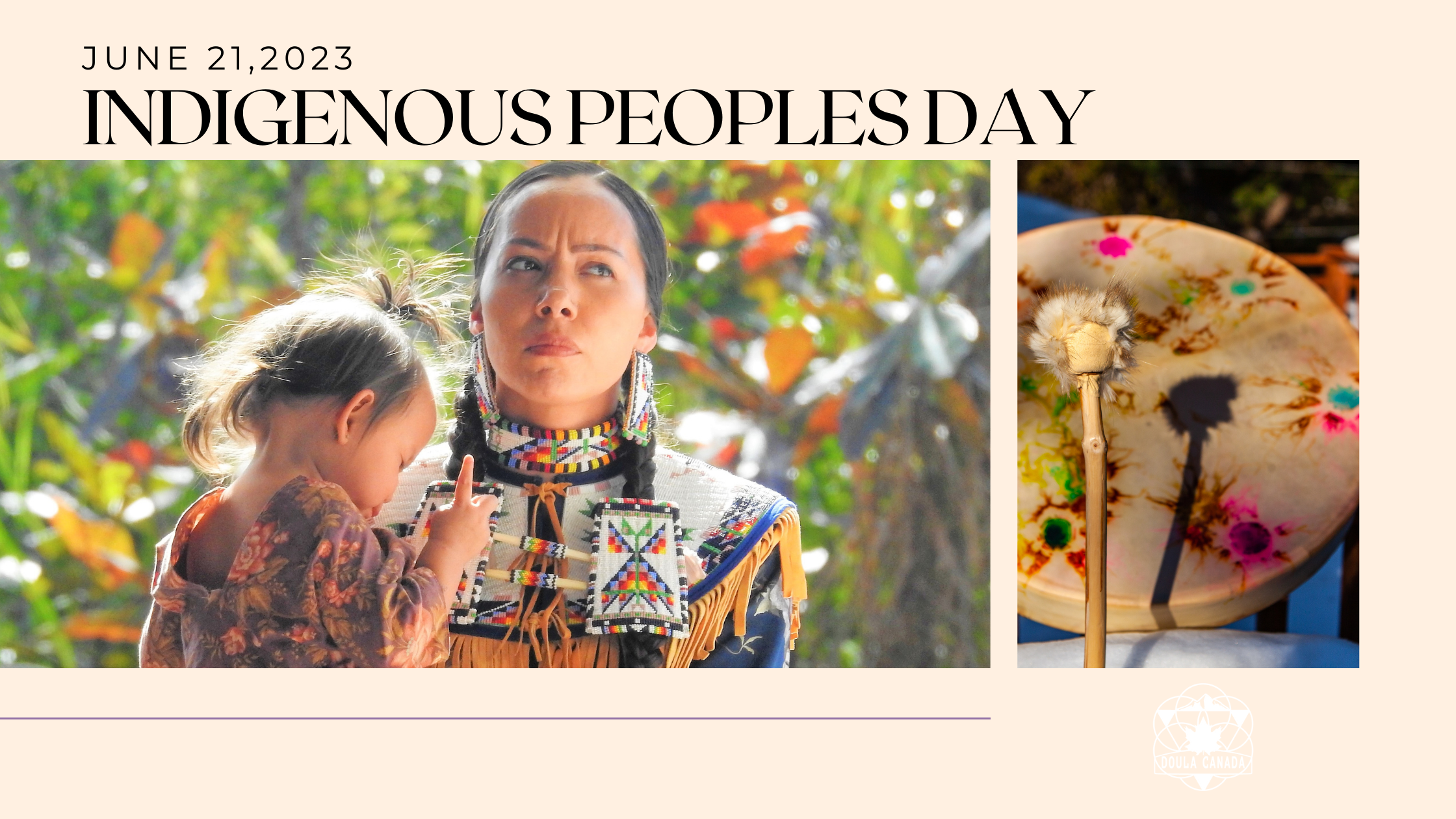
  • Let’s Celebrate Indigenous Peoples Day.

    Let’s Celebrate Indigenous Peoples Day.

    [vc_row][vc_column][vc_column_text css=”.vc_custom_1687365796950{margin-bottom: 0px !important;}”]Aaniin Doulas!

    This month is National Indigenous History Month, how have you been celebrating?
    The Indigenous excellence at DTC shines bright, and we are so grateful for the many contributions Indigenous birth helpers have brought to the community, historically and currently!
    We hope this Indigenous Peoples Day, Indigenous and Non-Indigenous folks can reflect on how to create more accessible care for Indigenous families, co-resist against systems, and use their doula roles to uphold Indigenous rights.
    Some ideas on how to celebrate Indigenous Peoples Day:
    1. Learn whose land you reside on. www.native-land.ca
    2. Attend a local or virtual Indigenous Peoples Day event
    3.  Donate to Indigenous-led organizations upholding Indigenous rights today
    4. Pick a film to watch from the National Film Board of Canada’s catalogue of over 200 Indigenous-created films
    5. Follow and amplify the voices of Indigenous people through social media platforms
    6. Read through the Indigenous Ally Toolkit or How to Become an Indigenous Ally
    7. Find a CBC Reclaimed playlist and explore the many different worlds of Indigenous music, or start by watching the documentary Rumble: The Indians Who Rocked the World
    8. Understand the issues facing Indigenous reproductive health in Canada
    9. Join me June 29  from 12-3 pm EST,  for a Celebrating Indigenous Changemakers: NIHM Watch Party and discussion on Turtle Island Heros. This is open to Indigenous and Non-Indigenous members. We will be screening some Indigenous pieces, including clips of award-winning documentaries, spoken word pieces, and music to celebrate Indigenous culture and history. We will also be having an open circle discussion about the pieces being viewed, and how they relate to doula care in Canada. register here
    At Doula Canada we continue working toward our goals outlined in the DTC Truth and Reconciliation Action Plan for 2023, and we are so excited to announce the launch of our Indigenous History and Allyship module, compulsory in all doula streams, starting in July. This is a three-month pilot, where we will take feedback and then relaunch a final module based on surveys afterward.
    We are on Indigenous land, and we must know how to be good relations with one another.
    Happy Indigenous Peoples Day and Happy Summer Solstice!
    I look forward to seeing you all on June 29 from 12-3 pm EST.
    Kayt

    [/vc_column_text][/vc_column][/vc_row][vc_row][vc_column][vc_separator][/vc_column][/vc_row][vc_row][vc_column][vc_column_text css=”.vc_custom_1687096542163{margin-bottom: 0px !important;}”]Kayt (she/her) Inclusion and Engagement Lead, is an Anishnaabe kwe from Bonnechere Algonquin territory and the owner of Sweetgrass Solace Wholistic Support. Her post-secondary education includes a Bachelor of Social Work and Bachelor of the Arts in Indigenous Studies from Trent University (2021). She is also a certified hatha yoga teacher and a certifying birth and postpartum Doula.[/vc_column_text][/vc_column][/vc_row]

  • Unlearning the Nuclear Family

    Unlearning the Nuclear Family

    [vc_row][vc_column][vc_column_text css=”.vc_custom_1685714926487{margin-bottom: 0px !important;}”]When I was a kid in the 80s, the family sitcom dominated television. From the Huxtables to the Keatons, to the Seavers, it was always Mom, Dad, and 2.5 kids. By then, the nuclear family had become the norm, so usually, both Mom and Dad worked outside the home. 

    I always knew I wanted to be a mom someday. Even though my family didn’t look like the ones I saw on TV (I was raised by an Aunt and a Grandma), somehow it never occurred to me that the family I made someday would look different from the ones I saw on TV. I always pictured Daddy, babies, and me.

    As I got older and came out as bisexual, my visions of future family life expanded to include the possibility of parenting with a “Daddy” or another “Mommy”, but I was still locked into a really nuclear understanding of what “families” looked like. 

    Now my life has taught me a lot better. I do parent my only child with my wife, but welcoming Baby into our family made so much more than three. Our chosen family comprised of friends and partners from our queer and polyamorous communities has always been a huge part of our parenting journey.

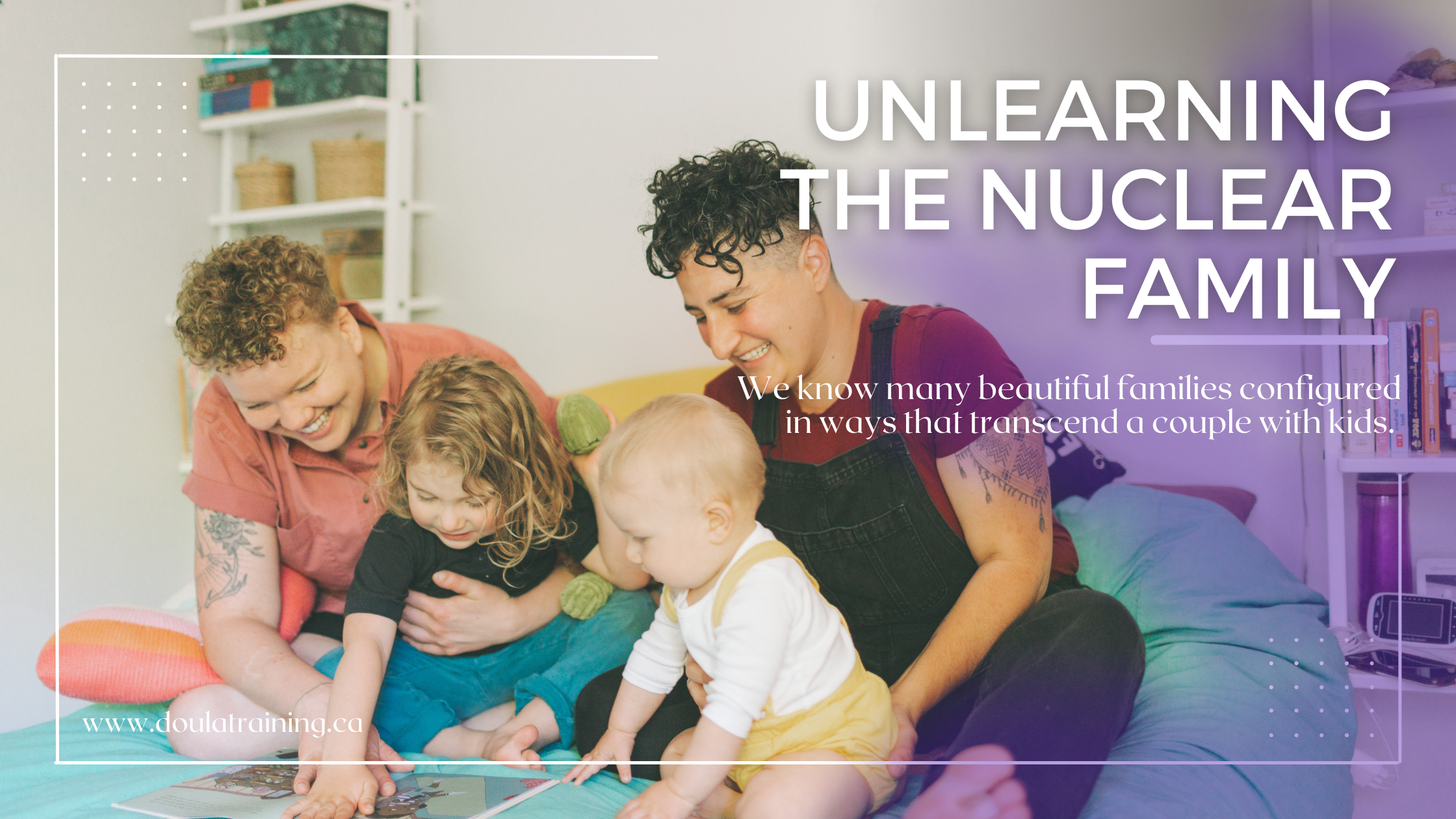
    We know many beautiful families configured in ways that transcend a couple with kids. We know quartets of a lesbian couple and a gay couple who have chosen to co-parent. We know gay and lesbian besties who have chosen to co-parent with their respective biological and chosen families behind them. We know lesbian couples with a known sperm donor who is deeply involved in their child’s life. There are triads or “thrupples” (a partnership involving 3 adults) who choose to raise families. This could look like a mom having a baby with each of her two male partners, or two women each having a baby with their male partner or any other number of ways of creating a family.

    The reality is that Queer and Trans Culture isn’t just about having a life partner who was assigned the same sex as you at birth. Our cultural norms are forged from a history where the most conventional, nuclear way that we could have a family was still socially unacceptable. Many of us and our queer elders were rejected by our biological families for being honest about who we are. As a result, our community has been resourceful and resilient in carving out new ways of defining “family” and building family units that allow us to be whole. We create our own villages that know who we are, where we’ve been, and where we’re going to support us while we child rear and do this thing called life.

    5 was a vital turning point for queer and trans families. It made the relationship to the child the focus of parental rights, rather than biology. The law also makes it possible for more than two people to be the legal parents of a child. This legal change was extremely important, but it’s only a fraction of the needed social change.

    We must unlearn the idea that “parent+parent+kid(s)=family”. There are infinite equations that can add up to a family. As professional support people, we can embrace the expectation that clients seeking our help could come in ones, twos, or more, reflecting any mix of gender identities. 

    We can also expect that folks living outside the parental binary are seeking our support specifically because they can expect that other parts of the health and social service systems don’t expect them, and might be hostile toward anything or anyone that challenges their expectations. We can create an unconditional blanket of compassion and support around all the beautiful shapes and sizes that families come in. That blanket is also a shield against fear and hate that preserves the sacredness of the parenting journey for all people.[/vc_column_text][/vc_column][/vc_row][vc_row][vc_column][mk_padding_divider][/vc_column][/vc_row][vc_row][vc_column][vc_column_text css=”.vc_custom_1686178152124{margin-bottom: 0px !important;}”]

    Keira Grant (she/her) Inclusion and Engagement Lead – Racialized Communities

    Keira brings a wealth of experience to the Online Community Moderator role. She is a Queer, Black woman with a twenty-year track record in Equity, Diversity, and Inclusion (EDI) education, projects, and community building initiatives.[/vc_column_text][/vc_column][/vc_row]
  • Why Representation Matters.

    [vc_row][vc_column][vc_single_image image=”502714″ img_size=”full” alignment=”center”][/vc_column][/vc_row][vc_row][vc_column][mk_padding_divider][/vc_column][/vc_row][vc_row][vc_column][vc_column_text css=”.vc_custom_1685976157863{margin-bottom: 0px !important;}”]As Pride month comes to a start, I decided to write a more personal piece for the Doula Canada blog. As many queer people know, the process of coming out isn’t linear nor a one time deal. Queer people often come out over and over, in every day interactions. We decide whether or not its safe to come out, whether or not it will have repercussions professionally, socially, and within our family circles. Pride comes with a lot of baggage. Working at a feminist vocational school, that celebrates diversity and inclusion, I know that writing this is a safe space. 

    You see, I’m freshly out. I’ve been “out” as pansexual for about five years, but being “conceptually queer” and “actively queer” feel very different. Not that pansexuals do not struggle, we do, but we have one of those “border” identities where we can experience privilege and oppression at the same time, i.e. “passing”. Being able to pansexual while being in opposite sex relationships had a sense of “safety” in it. I could identify as queer, but also feel accepted and included by following compulsory heterosexuality. 

    What is that you ask? Compulsory heterosexuality is the concept that society favors those who act in heterosexual ways. Our social norms favor heterosexuality, and it is assumed to be the default. You see this when someone asks you if you have a spouse of the opposite sex. When teachers can speak about their partners freely (as long as they are straight) and we assume things about strangers we do not know. Being conceptually queer, but passing as “actively straight” kept me safe. I didn’t have to have uncomfortable conversations, debate whether someone would be accepting of my partner, or wonder if it would be a deal breaker for a job. Until one day, passing didn’t work for me.

    I’m 28 years old from a rural area in Northeastern Ontario. I went to a Catholic school where bringing a partner of the same sex to prom was forbidden, and we were told our “lifestyles” were unnatural and against God. I came from an area where queer people were (visibly) few and far between, and if they were outed they were ostracized for being “predators” or other horrendous, homophobic things. At one point, I thought I was queer when I was about 14 years old. A school counselor told me that all girls feel that way at some point, and I believed her. As I grew up, I thought I was emotionally bankrupt to all my boyfriends, that perhaps I was asexual, or traumatized, and that one day I would marry a husband. Asexuality and trauma are valid, but for me, it was a mask that seemed “more appropriate or acceptable” than the thought that I may be attracted to women. I didn’t realize that most women don’t see finding a husband as a begrudging task on a to-do list. This was compounded by the “ball and chain” rhetoric of a heteronormative and often misogynist society. Dating, sex, and marriage is supposed to be disappointing if you are a woman with a man (we’re often told).  It was easier for me to believe I may be asexual or traumatized than to think I may one day marry a woman. This is when I realized, I may not be attracted to men at all. But I didn’t know what that would look like.

    Representation matters, because I had none. 

    I was 20 before I saw a lesbian in a professional role, that wasn’t actively trying to hide her identity from the institution she was employed from. She was my Women’s Studies 1000 professor, and I thought about how brave that was. I didn’t realize that queer women could be out in positions of power without punishment.

    I was 24 before I realized that you could be queer without ostracization in a bigger city. I was surrounded by queer friends who were living their joyful lives, loving their partners, and living (mostly) without harassment.

    I was 26 before I met my first queer couple with children. I was downtown Toronto and finally seeing lesbian and gay couples living loud and proud, and simple and boring just like any other couples. I had never seen pregnancy and childrearing in queer couples, and had always tied my dream of having kids with being in a heterosexual relationship. Representation changed this for me.

    How does this relate to doula work? Easy. If you’re a queer doula, you are actively showing the world that queer people belong in the doula space. If you’re creating inclusive advertising for trans and queer people, you are telling them you see them, and they belong in the reproductive health discussion. When you use a trans person’s pronouns, you are validating their experience and showing them you respect their identity. When you learn about surrogacy, IVF, and adoption support, you are creating more services for queer people to access.

    Representation matters because it shows queer youth, and queer adults that their experiences are normal, and can be expansive and joyful. It shows others the possibilities within being queer. It shows us our dreams can exist in a comphet society, and that we don’t have to give up a part of ourselves to be happy. So this pride, when you hear someone say “Why do they have to be so LOUD about it?” tell them its for every queer person who is forced to live quietly, and is silently listening.[/vc_column_text][/vc_column][/vc_row][vc_row][vc_column][vc_separator color=”violet”][/vc_column][/vc_row][vc_row][vc_column][vc_column_text css=”.vc_custom_1685976337654{margin-bottom: 0px !important;}”]

    Kayt (she/her) is an Anishnaabe kwe from Bonnechere Algonquin territory and the owner of Sweetgrass Solace Wholistic Support. Her post-secondary education includes a Bachelor of Social Work and Bachelor of the Arts in Indigenous Studies from Trent University (2021). She is also a certified hatha yoga teacher and a certifying birth and postpartum Doula.[/vc_column_text][/vc_column][/vc_row]