Category: Community & Lifestyle

Insights on balance, gratitude, connection, and building supportive communities within birth work. Personal reflections, lifestyle shifts, and stories of resilience from the doula journey.

  • Finding Balance: Working and Doula Life

    The question often comes up in doula circles “how do people manage to swing doula work and family or other jobs”. It can be especially hard for people, like me, who are just starting out and aren’t in a place yet where they’re able to give up their other job for financial reason. I’m here to tell you, as a new doula in an area with no other doulas yet, a full time paramedic, a first-time mom-to-be, a DIY home builder and the Doula Canada Provincial Liaison for Newfoundland, it’s not an easy task.

    There are two things that every doula must have, no matter their life situation. They must have a good support system and a love and deep desire for this work.

    I took my training with Doula Canada in the spring of 2017. After having the time to set up my business, I took on a client due in January, and left a full time work schedule to accept a casual position working as a paramedic. I live in a province that is in heavy need of paramedics, so I have been able to work full time hours, but have the flexibility to take time off as needed. I know that this is a great luxury that is not available to everyone, and I have grateful for the position that I’m in. Having that flexibility was wonderful, as I took off time while on call for my doula client, and then returned to work again after her birth. This also coincided with my first trimester of pregnancy, so it worked out well in that I probably wouldn’t have been able to manage on call life while sick and exhausted from this pregnancy.

    I would never be in the situation that I’m in without the unwavering support from my partner. When we decided that I would pursue this line of work, he supported me 100%. Even though we have had to tighten our shoestrings a bit in order for me to be on call periodically, he has recognized that for me to do work that will fill my cup, at times we will need to make some sacrifices in other areas of our lives. He also tags along to events with me, and listens to my many rants about the amount of work left to be done here! He’s a pretty good listener. I know moving forward with a child, he will allow me to take the time I need to focus on this business in whatever capacity that I need.
    The second piece to the balancing puzzle is the love and desire for this type of work. It’s a lot easier to find the motivation to make those contacts, reach out to potential clients, and ask questions to the people in the community, when you see the potential. I’m so excited to have the opportunity to be a real part of the shift in birth culture here in Newfoundland. There are lots of struggles, but so much potential, which really lights my fire. After every positive meeting, I find myself motivated to keep moving forward. After every negative encounter, I find myself driven to help make that change. It’s hard to look at how far we have to go and to know, realistically, how long it’s going to take to get there. But each assignment that gets submitted, each new like on my Facebook page, every acknowledgement by a once skeptic gets us closer to providing the right support to the families in our area!

    So how does this translate to you and your doula business?

    First of all, find your support team. It’s hard to support people through their pregnancy, birth and postpartum without being supported yourself. Whether you need family to take care of your kids when you get called to a birth, a reliable babysitter for your prenatal visits or postpartum shifts, a partner who helps to manage times of lower income, a friend to enjoy a cup of tea with or a Doula Canada counterpart to vent and debrief with about hard situations, we all need to build our support team.

    Figure out what you’ll need in order to make this a successful venture and then find the people to who will help you do that. Also be sure to add yourself to your support team.

    Self-care is vitally important if we are to remain an active member of this birth culture shift. Fill your cup in order to continue filling others. That love and passion for the work, which I think you need to be a truly good and effective doula, is only sustainable if we take care of ourselves.

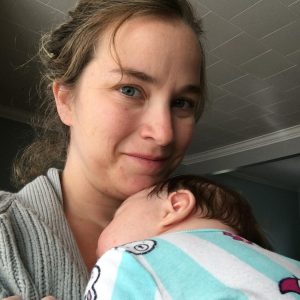
    Samantha is the Provincial Liaison for Doula Canada and the owner of Nesting Owl Doula Services in Newfoundland. She is originally from Nova Scotia, but has been living in Newfoundland for the last 7 years. She had been working as a paramedic for the last 10 years before having her first child this summer. She is passionate about bringing midwifery care to Newfoundland and Labrador.
  • Intersectionality: Why Looking Beyond Identity is Key in Sex and Birth Support

    [vc_row][vc_column][vc_column_text css=”.vc_custom_1547478060886{margin-bottom: 0px !important;}”]

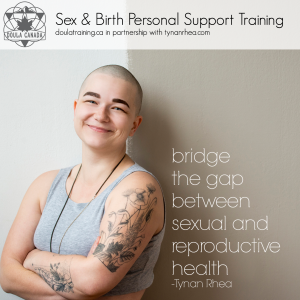
    If you’ve perused my course on Sex & Birth, you’ll notice that an entire module/week is devoted to intersectionality and voices from the margins right at the start of the course, so that these ideas remain with us throughout the rest of the weeks. Why is this important, you ask?

    First, I want to introduce you to a very important person: Jasbina Justice, the editor of the Sex & Birth Manual.

    I could not have done this work without the guidance and brilliance of Jasbina Justice. Jasbina Justice is an Intersex Femme queer person who is mixed. They are South Asian and Caribbean. They are a settler living on colonized land known as Tkaronto, Turtle Island, land of the Haudenosaunee, Anishinaabe, Mississaugas of the New Credit, Huron-Wendat and other Indigenous peoples. They live with an invisible disability and have Complex PTSD. They have been running workshops, doing consultations, and generally working in equity and social justice for the last five years. They are a poet, writer, multimedia artist, performance artist, community educator, facilitator, former sex worker, and yoga teacher.

    As a white settler, I knew I was going to need some help! It was working with Jasbina that helped me understand these 4 important reasons for the inclusion of intersectionality in this course:
    #1 Intersectionality is the understanding that the totality of our person cannot be understood by merely looking at each of our identities in isolation. Rather, it is at the intersection, or where these identities meet, where unique and compounded oppression’s can be found.

    The term intersectionality was coined by Kimberlé Crenshaw in the late 80’s when she was trying to find a way to explain black women who experienced obstacles not just because they were women and not just because they were black, but because they were both black and women. Here is a great video of Crenshaw breaking down the definition. This is important in sexuality education because…

    #2 Most sex education in Canada is taught from a white, colonial, cisgendered, able-bodied, heterosexual, middle-upper class, educated, incomplete perspective.

    Though about 72.5% of Canadians identify as white, this number continues to drop and dramatically changes depending on the area. In Tkaronto, specifically, more than 50% of folks belong to a visible minority (you can see the stats Canada breakdown here). In Saskatchewan, the indigenous population is predicted to increase threefold by 2045.

    In 2012, 11% of Canadians had some kind of physical or mental disability that limited their day-to-day life. Sex and disabilities is often disregarded at all levels of education (elementary, highschool, undergraduate), unless someone is specifically seeking to learn about this topic.

    Although the percentage of trans or intersex folks who birth is relatively small, it is all the more reason to make sure we are not lost in trainings because we are often lost in the literature and research.

    When you belong to a minority group, it is easy to feel isolated and not have information that is relevant to you. This exclusion from information is dangerous to all aspects of our health, including sexual health.

    (more…)

  • 2018, a year of connection – A message from our Director

    2018, a year of connection – A message from our Director

    2018.  A year of connection.
    A message of reflection from our Director.

    When the last light switch is turned off on our yearly trainings I like to sit back and reflect on the growth, the hiccups, and the bounty of support we have created at Doula Canada.  Were our 2018 goals achieved?  What were the lessons we learned?  How can we make this better for our members in the year to come?  

    365 days of continuous trainings and member support can feel like a daunting task at the turning of the new calendar year, but 2018 leaned towards healthy growth via the streamlining of our online learning centre and the dedication of our expert training staff.   In short, this past year was a year of vibrancy and commitment by our growing membership, our hardworking team, and the community of networking partners we set out to encompass.

    It was also a lot of fun!  We made videos, held webinars, and we increased our communitas for members who wished to take part in our online check-in’s, social media platforms, monthly newsletters, and closed community forums.  

    But fun wasn’t the only focus of this past year.  2018 was about making connections and beginning the work on collaborations both with and for our Doula Canada members.  The year allowed for us to ask and to receive.

    In Canada we found incredible partnerships in The Gabriel Dumont Institute and the onset of our Indigenous Doula program.  We set the groundwork for our doula programs to be offered bilingually through Collège communautaire du Nouveau-Brunswick (CCNB).  We continued to strengthen our relationship with Douglas College in New Westminster, BC, and we began discussions with multiple national partners to increase access to doula support through increased funding, alongside obstetrical partnerships, and increased awareness of maternal and infant mental health.  

    We are grateful to have held space and made plans with First Family Wellness (Regina), Beausoleil First Nation (Christian Island), BirthMark (Toronto), Hon. Min. John Haggie (Newfoundland) and his community partners, Canadian Mental Health Association (National), and a number of hospital administrators and boards.  We look forward to continuing our discussions and plans in 2019.

    Connections were also made outside of Canada as our team worked to create bridges between the maternal support needs of International communities and the strength of our Doula nation and its trainings.  Many of our members volunteered in countries like Honduras, Costa Rica, and Haiti, and in early 2019 a number of Doula Canada students will travel to Tanzania with Wombs of the World to work as alongside obstetrical support, and to increase access to safe water and sustainable job opportunities.  We will continue to support these initiatives as we make plans for future retreat and learning opportunities held abroad by Doula Canada in 2019.  

    Lastly, 2018 was a year of growth.  As an organization we saw our membership increase by over 38% from the previous fiscal year, and we expanded our certifications and workshop offerings to include expansive programs such as Infant and Pregnancy Loss, Sex and Birth, Rock Your VBAC, and the announcement of our Fertility Support and Menopause Practitioner trainings. 

    So, 2018, you were kind to us, and for that we are grateful.  Our organization at Doula Canada grew and created beautiful connections that we look forward to nurturing in 2019.   As the Director for this organization I am continuously grateful for the opportunities to learn from each of our members, for those who put forward their best intention to help our Learning Centre get off the ground, and for all the individuals who continue to show up for our profession and our communities.   I am also grateful to the Doula Canada team, who work 24/7, 365 days a year to support our growing membership and their professional needs.

    This New Year’s Eve we will ring it in with many new friends and colleagues, and for that we say…