Category: Community & Lifestyle

Insights on balance, gratitude, connection, and building supportive communities within birth work. Personal reflections, lifestyle shifts, and stories of resilience from the doula journey.

  • Supporting Disabled Parents

    Supporting Disabled Parents

    [vc_row][vc_column][vc_column_text css=”.vc_custom_1754426425616{margin-bottom: 0px !important;}”]Welcoming a new person into your home and the world is always an emotional and life-changing experience with so much joy, but also many challenges and adjustments. Imagine navigating all of the usual challenges, when additionally you can’t hear your baby’s cries, see if they are too hot or too cold, or don’t have the mobility to do diaper changes or easily lift your baby.

    This is a reality for many new parents, and it’s a reality we don’t see reflected in popular culture or in services and support for new parents. Disabled people are rarely depicted in parenting roles, despite the fact that 1 in 8 birthing people identifies as having a disability. One of the features of ableism is that disabled people are infantilized and not seen as sexual beings. As a result of these stereotypical and inaccurate beliefs, disabled people are assumed to not be parents. 

    Additionally, until well into the 20th century, disabled people existed in a climate of eugenics, where many disabled people were unnecessarily advised not to reproduce and in some instances, sterilized against their will.

    Even today, many disabled people report that they are discouraged from childbearing, and given inaccurate or misleading information about the impact of their disability on their fertility or ability to child bear. 

    There is a growing body of research that shows that perinatal care providers are woefully uninformed or misinformed about the needs of disabled pregnant people. Just finding a clinic with an accessible exam room and other disability accommodations can be challenging and severely limit provider choice. Physicians and midwives are not trained on the needs of disabled patients and they themselves report that they feel insecure providing care to disabled patients. 

    For parents who need assistance with newborn care, funded options are limited. In Ontario, there is a program called the Nurturing Assistance program. This program provides access to a support worker who can provide neonatal care under the parent’s direction, while the parent is present and involved in care. Support like this empowers parents to bond with their newborn while receiving assistance on their terms with the tasks that their disability limits them from performing. 

    While Nurturing Assistance is an excellent resource, there are many challenges with the current program. Firstly, only individuals who meet the criteria for the self-directed funding program are eligible for nurturing assistance. This means people who do not need a support person for their own activities of daily living, but who do need assistance with newborn care are not eligible for funding. As a result, only a small proportion of disabled parents in Ontario can receive support from this program. 

    Further, the support is usually provided by Personal Support Workers, often through agencies where the disabled parent is already receiving support. Personal Support Workers do not receive training on neonatal care and are often unwilling to accept such assignments or struggle to provide adequate support.

    Disabled parents who do not qualify for the Nurturing Assistance program must pay for a support person out of pocket if this accommodation is needed. 

    Whether the support person is paid out of pocket or through public funding for the rare families who qualify, support from a postpartum doula is an excellent way for disabled parents to receive nurturing assistance. More disabled parents need to be aware that trained support from postpartum doulas is available, and that funding from the Nurturing Assistance program can be used to hire doulas. Doulas need to be competent and comfortable providing support to disabled parents. They are key members of the parenting community who can truly benefit from the skills we bring to the table.

    [/vc_column_text][/vc_column][/vc_row]
  • What Doulas need to know about the Pelvic Floor

    What Doulas need to know about the Pelvic Floor

    [vc_row][vc_column][vc_column_text css=”.vc_custom_1650026862256{margin-bottom: 0px !important;}”]

    The pelvic floor is one of the most important elements to birthing beautifully, but many birth workers and health care providers do not appreciate just how integral it is to the birthing experience” says Pelvic Floor Physiotherapist Ibbie Afolabi

    Pelvic Floor Therapy is somewhat of a new element in supporting birthing people and those in the postpartum period.  However, the knowledge of its importance is gaining traction in the birth world.  

    So, what is the pelvic floor and why does it need therapy? Think of the pelvic floor like a hammock in your pelvis. It is a group of muscles that stretch from the front of the pelvis to the tailbone, or coccyx. It holds up the bladder, bowel and uterus. In most female and some intersex bodies there are 3 passages, or holes. Those are for the urethra, vagina and anus. They are held firmly by the pelvic floor muscles.  If the pelvic floor muscles are too tight or too loose, this can cause damage or trauma to the area during delivery, this can cause more extensive tearing or prolapse after a vaginal delivery. A pelvic floor therapist will work with you during pregnancy on exercises and muscle focus to help bladder leakage, relieve pelvic pain and discomfort, and help prepare you with breathing and positions for labour. This usually involves an internal exam.

    The postpartum person also benefits from pelvic floor physiotherapy. If there was a cesarean, a PFT can aid in internal scar healing. Ibbie says on a website biography “We treat incontinence, pelvic organ prolapse, constipation, pelvic pain, sexual pain and dysfunction, abdominal/gut issues, diastasis rectus abdominis, pregnancy related conditions, and much more.”

    With all this information, if you are pregnant or just had a baby, it may be worth looking into pelvic floor therapy.  It is covered under most Health Care insurance plans.  If you are a doula, I highly recommend you network for pelvic floor therapists in your area, go meet them, learn about what they do and add them to your resource list for clients.  Who knows, maybe they will start referring clients to you as well!


    Ibbie Afolabi can be found teaching courses and supporting people throughout Ontario, including with Doula Canada.  You can find here on these websites:

    [/vc_column_text][/vc_column][/vc_row][vc_row][vc_column][mk_button corner_style=”full_rounded” size=”large” url=”https://themamasphysio.com/” align=”center”]The Mama’s Physio[/mk_button][mk_button corner_style=”full_rounded” size=”large” url=”https://pelvicrehab.com/practitioner/ibukun-afolabi-mscpt-pelvic-health-physiotherapist/” align=”center”]Pelvic Rehab[/mk_button][mk_button corner_style=”full_rounded” size=”large” url=”https://stefanie-techops.wisdmlabs.net/courses/pelvic-floor-essentials-for-doulas-birth-practitioners/” align=”center”]Pelvic Floor Essentials for Doulas and Birth Practitioners[/mk_button][/vc_column][/vc_row]

  • The Ultimate Dream Team: Doulas and Partners

    The Ultimate Dream Team: Doulas and Partners

    [vc_row][vc_column][vc_column_text css=”.vc_custom_1642695988103{margin-bottom: 0px !important;}”]If you’ve ever thought, “I don’t need a doula! I have a partner(s),” this post is for you! 

    Your partner is (or partners are) pretty amazing and doulas are so happy to have them on board, however, doulas bring different qualities and backgrounds to birth and postpartum preparation and space than partners do. 

    Let’s talk about how your partner(s) and doula complement one another and each fill a vital role.

    The role of a doula and the role of your partner(s) during labor are vastly different but equally important.

    Let me explain….


    The Partner’s Role:

    The role of your partner(s) (who is/are emotionally attached to you) in labor is a tremendous asset to you in many ways. Your partner(s) provide(s) comfort to you in a way that your doula (aka a new connection) is simply not capable of.

    They know you intimately; your fears, your passions, your deep concerns, and your history. They can anticipate your reactions before you have even had them. They are the person/people you look to in life for support and they are likely the person/people you feel most comfortable being your real self with.

    Your partner(s) can get your oxytocin flowing (it plays an important role in labour and chestfeeding). Your partner(s) can cuddle, kiss, or massage you in intimate ways that only you and your partner(s) can share.

    This relationship in the birthing room and during postpartum is incredibly valuable, HOWEVER, it is not the doulas role.


    The Doula’s Role:

    The doula’s primary focus during your pregnancy and the postpartum period is education, followed by the support of the decisions you make. The doula is able to answer your questions and lead you to the resources you seek. Through learning about normal physiological birth and birth options, chestfeeding and postpartum concerns partners can feel confident in supporting their partners. But they also have the reassurance of knowing a perinatal professional will be there to guide them.

    The doula can actually bring you closer to your partner. By making sure that your partner’s needs are met (food, drink, and reassurance), the birther and partner(s) can work more closely together. The doula allows for the partner(s) to participate at their own comfort level. The doula can fill in and allow the partner(s) to participate as they wish, without leaving the birther or postpartum person’s needs unmet.

    The doula is trained to know what is “normal” and what is beyond the scope of normal. The doula’s experience (professional and sometimes personal) enables them to support you confidently. The doula creates a space where the birther and partner(s) are given the opportunity to ask questions and make informed choices.

    When a doula attends a birth or supports you in the postpartum period, they bring with them the strength and wisdom of those they have served before you. Being the sole emotional and physical support for a labouring or postpartum person can be overwhelming for some partners. If we look at the birth and postpartum periods throughout history, we often see birthers surrounded by other experienced humans offering continuous support. Our shift in birth norms over the last century has made it uncommon to have multiple continuous support people. Partners provide an intimate and essential role that cannot be replaced, but a doula can come alongside to help and enhance the experience. 

    The doula is great at talking about the huge transition that is new parenthood. Especially for first-time parents, it can be so important to have someone to talk to about the big life and identity changes that happen when you bring a new baby into your family. 

    The Doula has a network and knows when offering resources and referrals are needed (from pelvic floor physical therapy, counselling support, or chestfeeding resources, to house cleaning services, or information on newborn jaundice, and so much more). 


    Your birth or postpartum team is not an either/or situation, and no doula would (or could!) ever take the place of your partner. Doulas and partners complement one another and come together to provide loving, compassionate, and judgment-free support along the journey to parenthood. It’s important to assemble your team carefully and think about the mix of personalities and support styles you want involved in your experience, making sure everyone is prepared to walk alongside you with their unique gifts and skills.[/vc_column_text][/vc_column][/vc_row]

  • National Day for Truth and Reconciliation

    National Day for Truth and Reconciliation

    [vc_row][vc_column][vc_column_text css=”.vc_custom_1632997516706{margin-bottom: 0px !important;}”]September 30th is now National Day for Truth and Reconciliation. So what does this mean? How does it relate to doula care and birth work?

    The National Day for Truth and Reconciliation comes after decades of emotional labour and advocacy from Indigenous communities, as well as a year of grieving Indigenous children and investigating the tragedies of the residential school system. Not only did Indigenous families experience the horrors of this system, but many others as well, such as the epidemic of Missing and Murdered Indigenous Women and Girls (MMIWG), the 60’s scoop, and current extraction of environmental resources.

    This is not history. This is happening now. Something needs to change.

    Why are we asking members to reflect today? Besides being citizens on Indigenous lands, birth and postpartum workers interact directly with Indigenous families, and play an integral role in mitigating systemic oppression and intergenerational trauma.

    For example:

    • Providing culturally sensitive care and awareness when working with Indigenous families
    • Providing trauma-informed care for those impacted by violence and adult child survivors of the child protection system
    • Creating space for cultural birthing practices
    • Advocating against racialized medical violence

    Getting comfortable with truth and reconciliation requires a lot of discomfort. This is okay. It is only when we face our shortcomings head on that we can progress toward change. We welcome you to reflect on some questions today.

    Reflection Questions for Doulas:

    • How have I benefited from capitalism, colonialism, and extraction of resources?
    • How have I upheld colonial norms that can potentially cause harm?
    • What did I learn growing up about the history of Canada and Indigenous Peoples?

    When we can acknowledge we are a product of wider system indoctrinations like white supremacy, colonialism, etc. we can separate our character from the issues at hand. Good people can do harm. Good people are capable of racism, classism, and perpetuating colonial norms. Shame restricts us from moving forward.

    In an effort to show this to you, here is mine. As an Indigenous person, I am still capable of perpetrating colonial harm.

    1. I benefited from colonial post-secondary institutions and obtaining a western education
    2. I have upheld colonial norms in the social work field as a mandated reporter
    3. I learned in elementary school that Canada obtained the land fairly and through agreement with Indigenous Peoples. Since then, I have done a degree in Indigenous Studies and learned about the tragedies of colonialism.

    Don’t know where to start? Dr. Lynne Davis of Trent University and her class “Transforming Settler Relations” have compiled a database of Canadian initiatives that support allyship, education, and decolonization. Find an initiative here: https://transformingrelations.wordpress.com/

    You can take action today by signing up for our trauma series this fall. The workshop “Intergenerational Trauma: The Doula Connection” on October 28 from 7-8:30pm EST will focus primarily on working with Indigenous families impacted by trauma and systemic oppression. All proceeds will go to The Indigenous Foundation.

    To any Indigenous and non-Indigenous doulas who have questions, need support, or would like to chat about truth and reconciliation, please contact Kayt at kayt@stefanie-techops.wisdmlabs.net

    Miigwetch,
    Kayt Ward (She/Her)
    Indigenous Inclusion and Engagement Lead, BSW[/vc_column_text][/vc_column][/vc_row]

  • 215.

    215.

    [vc_row][vc_column][vc_column_text css=”.vc_custom_1622592235107{margin-bottom: 0px !important;}”]We acknowledge and honour the 215 children whose unmarked graves were found at Kamloops Indian Residential School last week. Their deaths, as well as their short lives as residential school victims, are acts of terrible violence.

    These 215 children represent only a small fraction of those who have lost their language, culture, families, and lives to the residential school system in Canada and the residential school system is only one element of ongoing colonialism and cultural genocide in Canada.

    As birth workers, and as Doula Canada, it is our responsibility to name and resist the ways in which colonialism and cultural genocide show up in our work: in the practice of birth alerts; in the overrepresentation of Indigenous children in child welfare systems; in the erasure, dismissal, and coopting of Indigenous birth practices; in the systemic oppression present in healthcare settings; in the ongoing violence perpetuated against Indigenous children and families; in intergenerational trauma that this has caused. As Doula Canada, we are holding ourselves accountable for how these show up in our curriculum, teaching, and engagement with members. This work is imperfect, ongoing, and necessary.

    We send our love and rage to our Indigenous members, colleagues, friends, clients, and families. We are so very sorry for your children.

    [/vc_column_text][vc_separator color=”white”][vc_column_text css=”.vc_custom_1622592102485{margin-bottom: 0px !important;}”]Resources:

    Indian Residential School Survivors Society: https://www.irsss.ca/

    Plain Talk Residential Schools Guide, Assembly of First Nations: https://education.afn.ca/afntoolkit/learning-module/residential-schools/

    Tk’emlúps te Secwe̓pemc (Kamloops Indian Band) Office of the Chief May 27, 2021 Press Release: https://tkemlups.ca/wp-content/uploads/05-May-27-2021-TteS-MEDIA-RELEASE.pdf

    Truth and Reconciliation Commission Findings and Calls to Action: http://www.trc.ca/about-us/trc-findings.html

    Truth and Reconciliation Commission Missing Children Project: http://www.trc.ca/events-and-projects/missing-children-project.html

    Canada’s Residential Schools: Missing Children and Unmarked Burials: The Final Report of the Truth and Reconciliation Commission of Canada, Volume 4 (available for purchase in English and French):

    https://www.mqup.ca/canada—s-residential-schools–missing-children-and-unmarked-burials-products-9780773546578.php

    https://www.mqup.ca/pensionnats-du-canada—enfants-disparus-et-lieux-de-s–pulture-non-marqu–s-products-9780773546677.php?page_id=118863&

    CBC Docs: My auntie survived residential school. I need to gather her stories before she’s gone.:
    https://www.youtube.com/watch?v=ToUVHjr1xK0

    A national Indian Residential School Crisis Line has been set up to provide support for former students and those affected. People can access emotional and crisis referral services by calling the 24-hour national crisis line:

    1-866-925-4419

    [/vc_column_text][/vc_column][/vc_row][vc_row][vc_column][mk_button corner_style=”full_rounded” size=”x-large” url=”https://bhn.cmha.ca/national-indian-residential-school-crisis-line/?mc_cid=01ee69929e&mc_eid=810fcff83c” align=”center” fullwidth=”true”]National Indian Residential School Crisis Line[/mk_button][/vc_column][/vc_row]

  • Virtual Support – Options & Opportunities

    Virtual Support – Options & Opportunities

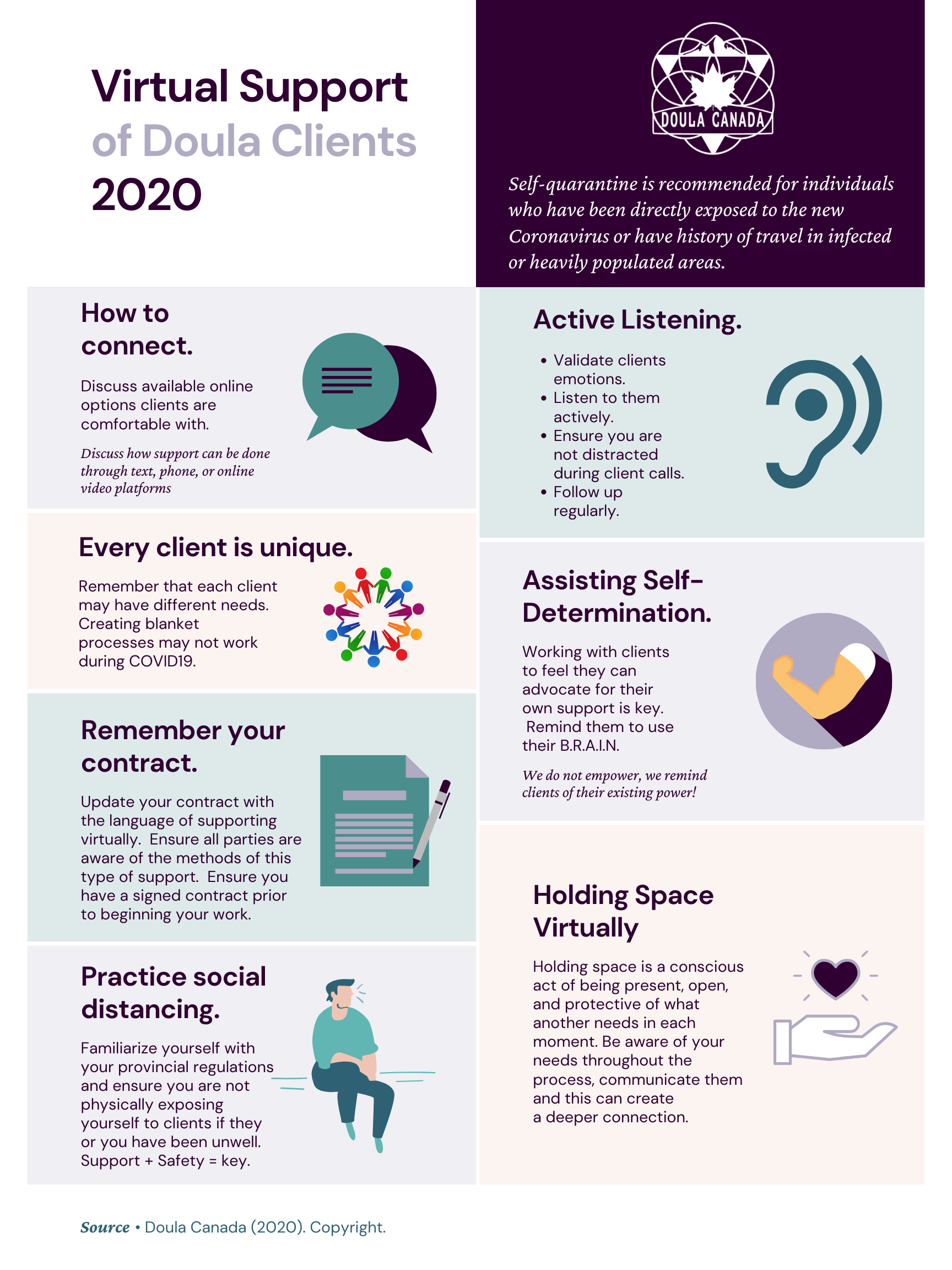
    [vc_row][vc_column][vc_column_text css=”.vc_custom_1588272004469{margin-bottom: 0px !important;}”]Being a doula or educator in 2020 means being creative!

    Amid the changing social times of COVID19 many support persons are finding new ways to connect with clients and hold space for their new experiences in labour, birth, and the postpartum period.

    Doula Canada will be updating our members with new resources, hand outs, and templates related to virtual support throughout May 2020.

    Check back to this page regularly for new additions and virtual support suggestions![/vc_column_text][mk_padding_divider][/vc_column][/vc_row][vc_row][vc_column][vc_btn title=”Virtual Support Suggestions: For Doulas” style=”classic” shape=”square” color=”mulled-wine” size=”lg” align=”center” link=”url:%2Fwp-content%2Fuploads%2F2020%2F04%2Fvirtual-support-of-doula-clients-2020.pdf||target:%20_blank|”][/vc_column][/vc_row]

  • Equanimity and Learning to Sit Amidst Discomfort

    Equanimity and Learning to Sit Amidst Discomfort

    [vc_row][vc_column][vc_column_text]What is the secret to longitivtiy as a professional support person?

    Is it business savvy, resiliency, or luck?  Perhaps it is a bit of each, and then some.

    Lately our Director at Doula Canada has been meditating on what it means to be a doula with tenure; what it takes to not only make birth work a life-long career, but what is also means to be championed through the eyes of ones clients.

    The secret?

    Read on.[/vc_column_text][mk_padding_divider][/vc_column][/vc_row][vc_row][vc_column][vc_column_text css=”.vc_custom_1572910346032{margin-bottom: 0px !important;}”]Today I would like to explore the importance of equanimity and strengthening ourselves through the experience of learning to sit amidst discomfort.

    As birth workers we are called by our clients to support them through their own needs, and sometimes that can create discomfort in our own bias, philosophies, and called upon memories.

    We bear witness to some of the most miraculous experiences of life, but many a doula can speak to unexpected situations that have triggered their fears and lessened their professional resolve.  Sometimes the miraculous can turn into worrisome, and our exposure to emotions, pain, and anxiety can rock our psychological stability.

    Equanimity, the ability to remain psychologically composed through all types of experience, has become synonymous with the word “doula” in my career of supporting families.

    Actual synonyms for the word “equanimity” are peace, calm, composure and poise, and at DTC our team often speaks to the importance of these practices not only in the support of our clients, but for our lives in general.  For we have long learned as doulas that in the face of adversity, equanimity can lead to leadership, positive outcome, and balance.

    Mature equanimity brings a radiance and a confidence.  It allows our clients to see the warmth of our being, even in the most unexpected of experiences.  It is the ability to see without being caught up in what we see, and to observe from a place of holistic support unmarred by our own prejudice or bias.

    Learning to embrace equanimity and to sit within discomfort also allows us to see the entire picture.  It ensures that as doulas we can use our understanding and emulate patience in an environment full of high running emotions.  It removes our impulse to be reactionary and always have “the answer,” when sometimes it is the pause between the words that holds the power of what we can suggest.

    Equanimity can often be promised through the wisdom of time, and the power of experiencing uncomfortable situations.  However, as a new doula it is important to remember that equanimity is not harnessed solely by years of experience. It can also be called upon through the understanding that people are responsible for making their own decisions and that as a birth worker we are not solely responsible for their well-being.

    Take a moment to think about how you practice equanimity in your daily life.

    There’s a beautiful poem about deepening our resilience to discomfort and challenge, it reads:

    “Where would I find enough leather to cover the entire surface of the earth?

    But with leather soles beneath my feet, it’s as if the whole world has been covered.

    Likewise, it’s not possible for me to restrain the external course of things,

    but should I restrain this mind of mine, what would be the need to restrain all else?”

    We don’t have control over all else but do have control over our self.

    We don’t need to cover the world with leather, instead, we toughen the leather on our own feet so that we are more resistant to it.

    -Shantideva, 8th Century Indian Buddhist Monk


    The message of this poem is that we often don’t have control over what happens in life, but we do have control over our response.  We can become more resistant to discomfort but embracing peace, calm, and composure.  And we can become a championed doula in the eyes of others by remaining equanimous.  We can learn to sit in discomfort and observe the space between uncertainty and knowing.  We can do(ula) our best in those moments.


    How do you practice equanimity in your daily life?

    What moments of discomfort stand out to you as times when you practice composure and calm?[/vc_column_text][/vc_column][/vc_row]

  • Gratitude:  A blog by member Stefanie Blackman

    Gratitude: A blog by member Stefanie Blackman

    [vc_row][vc_column][vc_column_text]

    As we approach the Thanksgiving season, I’m finding more quiet moments to reflect on all the ways in which I’m grateful. I’m thankful for my growing family, our health, our friends, and all of the people who have had a positive impact on me since starting my fertility doula business and journey with Doula Canada.

    It was just this year that I decided to pursue a career as a fertility doula and enrolled in the March 2019 self-study Fertility Support Practitioner training with Doula Canada. I am grateful for the online webinars in which my classmates and I chatted about our own experiences with our personal fertility and what we learned from working with clients. I am grateful for the wealth of knowledge and experience provided by our instructor, Caylan Barber, and her unwavering support when we needed it.

    It’s been a short seven months since starting my business and not surprisingly, it’s a slow process making my way through this line of work. It’s easy to forget sometimes that part of being a doula is also being an entrepreneur and a business owner. I’m grateful for all the people who have pointed me in the right direction, answered my questions, and who genuinely want to see me succeed in supporting menstruators everywhere. This process has opened my eyes to the possibilities of how I can reach more people and also continue to stay home with my children.

    I, of course, could not make this dream a reality without the support of my family and my husband, who may not always understand everything that I do, but understands that this is something that fills my cup and thereby makes me a better Mom and better human being.

    Lastly, I love being a doula for many reasons, but being of service to others has opened me up in ways that I never thought possible (I love me a good spiritual transformation!). Learning to make and hold space for others as they move through their own journeys toward truth, letting go of ego as well as what is “right” or what “should be” and instead being present to embrace what is. It’s the most challenging yet most rewarding aspect of this calling and I am eternally grateful and humbled for the way it has changed me.

    [/vc_column_text][mk_padding_divider][/vc_column][/vc_row][vc_row][vc_column width=”1/2″][vc_single_image image=”146678″ img_size=”full”][/vc_column][vc_column width=”1/2″][vc_column_text css=”.vc_custom_1569859911235{margin-bottom: 0px !important;}”]About Stefanie:

    Stefanie Blackman Fertility is a service-based business that focuses on fertility awareness, menstrual cycle education, preconception and reproductive health, trying-to-conceive support, and specializing in cycle charting using the Symptothermal Method of fertility awareness. The period of preconception is often not given adequate consideration but is a crucial part of the trying-to-conceive journey. As I always like to say, “plan for pregnancy like you would for your wedding.” While I’m passionate about this part of my fertility doula work, my goal with all of my clients is to unveil the power they have always possessed by using fertility awareness to reconnect to their cyclical nature, to embrace and honour menstruation as a sign of health rather than a monthly nuisance, and to make empowered, informed choices based on their reproductive goals.

    Starting at the age of sixteen and through my own diverse experiences with hormonal birth control, conceiving two children, and experiencing miscarriage, I have learned just how important the role of the menstrual cycle is in our overall health, and how it can be used as a fifth vital sign for all menstruators. I have a newfound appreciation and love for my menstrual cycle. I embrace and honour my cyclical nature, and I bring this holistic perspective into my work as a fertility doula when educating others on their own fertility and reproductive health.

    [/vc_column_text][/vc_column][/vc_row]
  • Our June Newsletter is Here!

    Our June Newsletter is Here!

    [vc_row][vc_column][vc_column_text]Interested in hearing more about our DTC is moving towards bilingual support, our latest endorsement of the National Aboriginal Council of Midwives, and a little gift we prepared for you?

    Check out our early June 2019 newsletter![/vc_column_text][mk_padding_divider][/vc_column][/vc_row][vc_row][vc_column][vc_btn title=”CHECK OUT OUR NEWSLETTER HERE” style=”classic” shape=”square” color=”mulled-wine” size=”lg” align=”center” link=”url:%2Fwp-content%2Fuploads%2F2019%2F06%2Fdoula-training-canada_-june-newsletter.pdf||target:%20_blank|”][mk_padding_divider][/vc_column][/vc_row]

  • DTC Endorses the National Aboriginal Council of Midwives position statements (2019)

    DTC Endorses the National Aboriginal Council of Midwives position statements (2019)

    [vc_row][vc_column][vc_column_text css=”.vc_custom_1559663840699{margin-bottom: 0px !important;}”]

    For Immediate Release: May 31, 2019 (MADOC, ON, CANADA)
     
    Doula Training Canada© endorses the National Aboriginal Council of Midwives’ Position Statements on Evacuation for Birth, Indigenous Child Apprehensions, and Forced and Coerced Sterilization of Indigenous Peoples
     
    The National Aboriginal Council of Midwives (NACM) has released three position statements on evacuation for birth, Indigenous child apprehensions, and forced and coerced sterilization of Indigenous Peoples. In the position statements, NACM condemns the:
    routine and blanket evacuation of pregnant people for birth and demands the return of birthing services to all Indigenous communities;
    over-representation of Indigenous infants and children in child protection services across the country; and
    forced, coerced, and involuntary sterilization of Indigenous Peoples.
     
    As an ally organization to Indigenous Peoples, and as an organization that strives to do better for Indigenous families, Doula Canada officially endorses the NACM position statements. The Doula Canada’s mission is to improve perinatal, infant and family well-being by educating and supporting professional doulas in Canada and around the world. Doula Canada supports all persons in their rights to bodily autonomy and free and informed consent. We support the inherent right of Indigenous Peoples to birth in their own communities, to access safe and culturally relevant care close to home, and to restore Indigenous birth practices.
     
    Doula Canada recognizes that we have a role to play in making doula training and doula services more accessible to Indigenous Peoples. We are committed to respectful, inclusive and reciprocal relationships with Indigenous doulas and health care providers, and the Indigenous families and communities we serve.
     
    We acknowledge that Indigenous doulas are ideal companions for Indigenous families. To provide equitable access to doula training and to increase the number of professionally trained Indigenous doulas, we are launching an Indigenous Doula Scholarship in September 2019.
     
    The complete position statements can be found at NACM’s website at https://indigenousmidwifery.ca/position-statements/.

    [/vc_column_text][mk_padding_divider][vc_btn title=”Download PDF copy of Media Release” style=”classic” shape=”square” color=”mulled-wine” size=”lg” align=”left” link=”url:%2Fwp-content%2Fuploads%2F2019%2F06%2Fdtc-endorsement-of-nacm-position-statements-for-immediate-release.pdf||target:%20_blank|”][mk_padding_divider][/vc_column][/vc_row]