Category: Community & Lifestyle

Insights on balance, gratitude, connection, and building supportive communities within birth work. Personal reflections, lifestyle shifts, and stories of resilience from the doula journey.

  • Alumni Journey – Helena’s Doula Path

    Alumni Journey – Helena’s Doula Path

    [vc_row][vc_column][vc_column_text css=”.vc_custom_1692469499559{margin-bottom: 0px !important;}”]

    Alumni Journey – Helena’s Doula Path

    Where it all began –

    Back in 2011, being a stay at home mom for over 10 years, working only part time here and there to keep me home with the kids – it was time for change. BIG change. I was losing my sense of self, kids were getting older, my husband had just changed careers and I needed something for ME. I always had a passion for women’s health, nutrition, natural healing. I looked into a few options, but midwifery REALLY resonated with me. Before I could even apply, I needed to upgrade some high school courses to get my grade point average up (apparently my memory of what a great student I was back in high school wasn’t…so…accurate…). I began looking into other things that could help boost my application and that’s when a trusty google search popped the word “doula” in front of my face. I am a mother of three and had never heard of a doula before – but man did it sound like a perfect thing to learn about while trying to pursue my goal of becoming a Midwife. I sneakily went into my “secret stash” of money that I was saving for a new camera and booked myself into a doula training course just 10 minutes from my house. Literally decided to take doula training on a Tuesday, enrolled for that Friday and the rest is HISTORY.

    From the moment I attended my first birth as a doula, I knew I was meant to be on the emotional side of birth…NOT the medical. So I tucked my midwifery goals aside, dove head first into my Doula Career and became certified. My Trainer was none other than Stefanie Antunes and since that first weekend together, we have become lifelong friends and “soul sistas”. Stefanie is the real deal people, she’s been there, done that, always re-inventing herself and truly a driving force for better birth.

    Stefanie also had this little “project” called the Birth Doula Program she had just launched before I met her and she needed someone to take the reins and work alongside her for a bit. I applied for the position and her and I have been partners in crime to this day, nurturing what many have viewed as a lost cause (more on that in a bit).

    A few years later, I found myself wanting to do as much education as I was “doula-ing”, so looked into Prenatal Educator Programs. Once again, I was trained by Stefanie and this time the added bonus of an old high school friend and colleague Jen Rogers. By 2016 I achieved my Lamaze Certified Childbirth Educator.

    I have been on the Board of Directors for the Association of Ontario Doulas. I have managed the Discover Birth Team. I have consulted with Health practitioners across Durham region helping them to expand the support they offer their expecting clients. I have facilitated seminars and info sessions for Doctors, Midwives, Nurses and colleagues. Give me a microphone people – the stage is my jam.

    First and foremost though, I have walked the walk. I have listened more than I have spoken to truly understand a family’s fears and intentions. I have driven the miles, put in the hours, lost the sleep, and cried the tears. Left my kids recitals and missed birthdays. I’ve laughed, hugged and done more hip squeezes than I care to count (in positions I can’t even describe). I may be 50lbs overweight but no one holds a candle to my arm and shoulder strength. I’ve doula’ed through the pandemic – when human rights were being violated, but technology kept the doula in the birth room. I’ve needed support after a long hard birth and I’ve given it right back – even at 2 am when I WASN’T on call. I’ve even had the honour of performing Henna Belly blessings and learning all about the different beautiful cultural traditions of birth.

    These past 10 years have been life changing. I’m a better mother, friend and wife because of this career and nothing beats the moment a birthing person looks you in the eye after the hardest and most impactful time of their life and no words even have to be spoken – you just feel the energy in the room – they did it and you helped that confidence bloom.

    Being a Doula is a privilege. It’s truly a gift, never to be taken for granted. I lost my mother very young (she passed away from cancer at 39 years), so I know how precious life is. I really feel I was meant to do this work – be there for families, for women, for people.

    Some of my favourite memories, so far:

    *Medical professionals remembering me from a previous birth and exclaiming to the room, we are in “good hands”.

    *Coming full circle as a colleague in the “birth world” when Stefanie and I were ready to change the previous model of the Birth Doula Program and expand it into more hospitals. We secured a meeting with The Director of the Alongside Midwifery unit at Markham Stouffville Hospital. She knew Stefanie professionally and she knew me from attending births together with clients under her care.  After hearing our “pitch” she said: “You are the ones mentoring these doulas and running this program, so I have every confidence they are getting the right support. If you’re teaching them, how I know you both are as doulas, then I see no problem in launching this program”

    Or at least I think that’s kinda what she said…cause I was having a surreal girl crush kinda moment being complimented by Ontario’s Midwife # 1 and head of Canada’s first Midwifery led hospital unit…

    *Those moments: when you don’t know you’re being watched, when you don’t know yet the ripple effect you’re causing. When the support you give rolls into 100’s of doulas lives – helping them launch their careers and in turn helps 100’s of families.  It weaves into a new parent’s confidence as they bring their baby home. Impresses knowledge so a family can make the best choice for themselves.

    As I approach a crossroads in my career, deciding whether or not to hang up my doula shoes, I look back on those moments and feel nothing but gratitude.

    Two years ago I put my doula career on hold as we moved from the city to the country and I was a surrogate. Having supported many families with that dynamic of growing their family, it was an honour to have been able to do that for someone. My daughter was able to be there at the birth too – how serendipitous to have had her there experiencing a true miracle. A beautiful little girl was born right on her due date (Thanksgiving Day!) and since then I have only been taking a few clients and teaching online here and there.

    My husband’s renovation company is also thriving, so I’ve enjoyed jumping in and learning to manage things together with him.

    In the past year, I have stepped away from the Birth Doula Program to a more quiet role (but still help with training new Doulas). I don’t belong to any birth related Boards or Associations (except my son’s local Hockey Centre Board). I’ve also said I’m retiring from doing births and only want to teach part time.

    So don’t tell my husband that I bought new doula shoes, booked up my October with classes and may have booked a couple clients the month we are supposed to be taking a family vacation…this Doula isn’t going anywhere.

    Parting words?

    Listen more than you speak.

    Surrender to the moments in labour so you can grow your confidence and truly be present for the person trusting you with this experience.

    Don’t spread yourself thin – I have missed ONE birth out of 100’s in 10 years…I wanted to hit the ground running and DO everything when I started my career. Instead be truly MAGNIFICENT in one or two things you do, instead of OKAY in many.

    Check your bias at the door.

    Stay Hydrated…legit


    Helena McMann

    Doula School Graduate

    CD(DONA) Doula

    LCCE Lamaze Childbirth Educator

    Co-Director, The Birth Doula Program[/vc_column_text][/vc_column][/vc_row]
  • Why We Need More Human Milk

    Why We Need More Human Milk

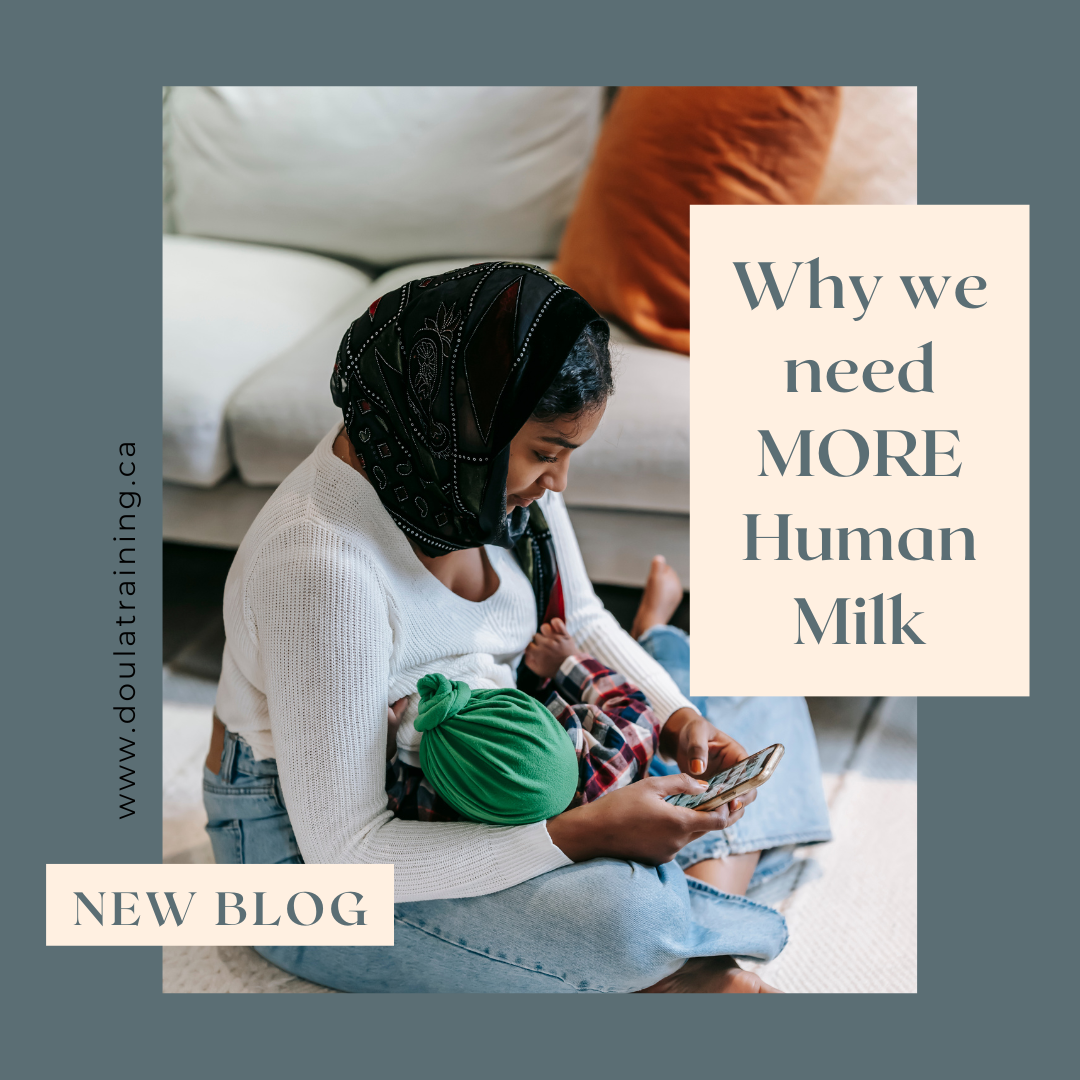
    [vc_row][vc_column][vc_single_image image=”509749″ img_size=”full” alignment=”center”][/vc_column][/vc_row][vc_row][vc_column][mk_padding_divider][/vc_column][/vc_row][vc_row][vc_column][vc_column_text css=”.vc_custom_1690821411248{margin-bottom: 0px !important;}”] At Doula Canada we celebrate August  as Human Lactation Month. A month of honouring and celebrating the many lactation weeks that happen throughout August. Including but not limited to  World Breastfeeding Week 2023 is from Tuesday 1st August – Monday 7th August 2023. Indigenous Milk Medicine Week is held annually August 8-14.  Black Breastfeeding Week runs August 25th – 31st.  As we honour Human Milk pay attention to our blog and social media for more information and takeaways throughout the month.[/vc_column_text][/vc_column][/vc_row][vc_row][vc_column][mk_padding_divider][/vc_column][/vc_row][vc_row][vc_column][vc_column_text css=”.vc_custom_1690820935893{margin-bottom: 0px !important;}”]

    Why We Need More Human Milk

    I had a conversation with a new colleague with expertise in lactation support that blew my understanding of late-stage capitalist discourse on breast/chestfeeding wide open. She said that when we talk about the benefits of breastfeeding we construct formula as the baseline and feeding infants human milk as an added bonus. The construct should be to perceive human milk as a baseline and formula as an intervention that has risks and benefits and is to be used when feeding human milk is not an option.

    Most of the clients I work with prenatally have a strong goal of feeding their baby their own milk exclusively for at least the first 6 months of life, and continue nursing after food introduction. Some have a goal of nursing for, up to two years. My clients understand that this goal tracks with evidence-based infant feeding recommendations. (The Public Health Agency of Canada, Health Canada and the World Health Organization) What they are often blindsided by is just how many obstacles exist to achieving that goal. 

    Talking about the joys and the barriers to feeding our babies our milk is vital during Human Lactation Month (commonly known as Breastfeeding Awareness Month). Many of the specific obstacles to meeting feeding goals that I have seen are rooted in silence that starts long before the pregnancy.

    Many of us have never held a baby or seen someone nurse before we’re attempting to feed our firstborns for the first time. That’s not normal. It used to be that our efforts to initiate chest/breastfeeding came after a lifetime of watching other milk-producing members of our community do this important job. As a result, we have a lot of catching up to do while we are overwhelmed with getting to know our new babes.

    There is also silence about our bodies. We encounter people who have never touched their breasts and are uncomfortable with learning hand expressions. There are those who have never heard of colostrum and are therefore susceptible to well-meaning advice from family or professionals that their supply is not enough and that they need to supplement with formula on day one or two. 

    And there is silence about the impact of intergenerational and individual trauma. There are Black folks who unexpectedly feel the humiliation of slave wet nurses rising inside them across time when they put their own newborns to the breast. There are Indigenous folks whose mothers have repeated to them what they heard from doctors in hospitals, away from their communities “formula is better than your breastmilk”.

    The current evidence continues to be irrefutable that our milk is best for our babies. The probiotics in each person’s milk are custom designed for their baby, resulting in optimized digestive, immune, and cognitive functioning, and many other health indicators.  

    If milk from the biological parent is not an option, human milk from a donor is the next best thing. Of course, there are many obstacles to human milk sharing as well, with attempts to walk this road often leading right back to formula.

    Over the course of this month we’ll be sharing some fun, interactive content in support and celebration of human milk. Stay tuned for a lactation recipe box, an infographic on milk sharing, and some fun facts and tips about getting those juices flowing. Wishing you a productive August![/vc_column_text][/vc_column][/vc_row][vc_row][vc_column][mk_padding_divider][/vc_column][/vc_row][vc_row][vc_column][vc_column_text css=”.vc_custom_1690821366833{margin-bottom: 0px !important;}”]Keira Grant (she/her) brings a wealth of experience to her EDI Co-Lead role. She is a Queer, Black woman with a twenty-year track record in Equity, Diversity, and Inclusion (EDI) education, projects, and community building initiatives. As a mom and partner she uses her lived expereince to provide support and reflection for her clients and her work. Keira is the owner of Awakened Changes Perinatal Doula Services.[/vc_column_text][/vc_column][/vc_row]

  • Unlearning the Nuclear Family

    Unlearning the Nuclear Family

    [vc_row][vc_column][vc_column_text css=”.vc_custom_1685714926487{margin-bottom: 0px !important;}”]When I was a kid in the 80s, the family sitcom dominated television. From the Huxtables to the Keatons, to the Seavers, it was always Mom, Dad, and 2.5 kids. By then, the nuclear family had become the norm, so usually, both Mom and Dad worked outside the home. 

    I always knew I wanted to be a mom someday. Even though my family didn’t look like the ones I saw on TV (I was raised by an Aunt and a Grandma), somehow it never occurred to me that the family I made someday would look different from the ones I saw on TV. I always pictured Daddy, babies, and me.

    As I got older and came out as bisexual, my visions of future family life expanded to include the possibility of parenting with a “Daddy” or another “Mommy”, but I was still locked into a really nuclear understanding of what “families” looked like. 

    Now my life has taught me a lot better. I do parent my only child with my wife, but welcoming Baby into our family made so much more than three. Our chosen family comprised of friends and partners from our queer and polyamorous communities has always been a huge part of our parenting journey.

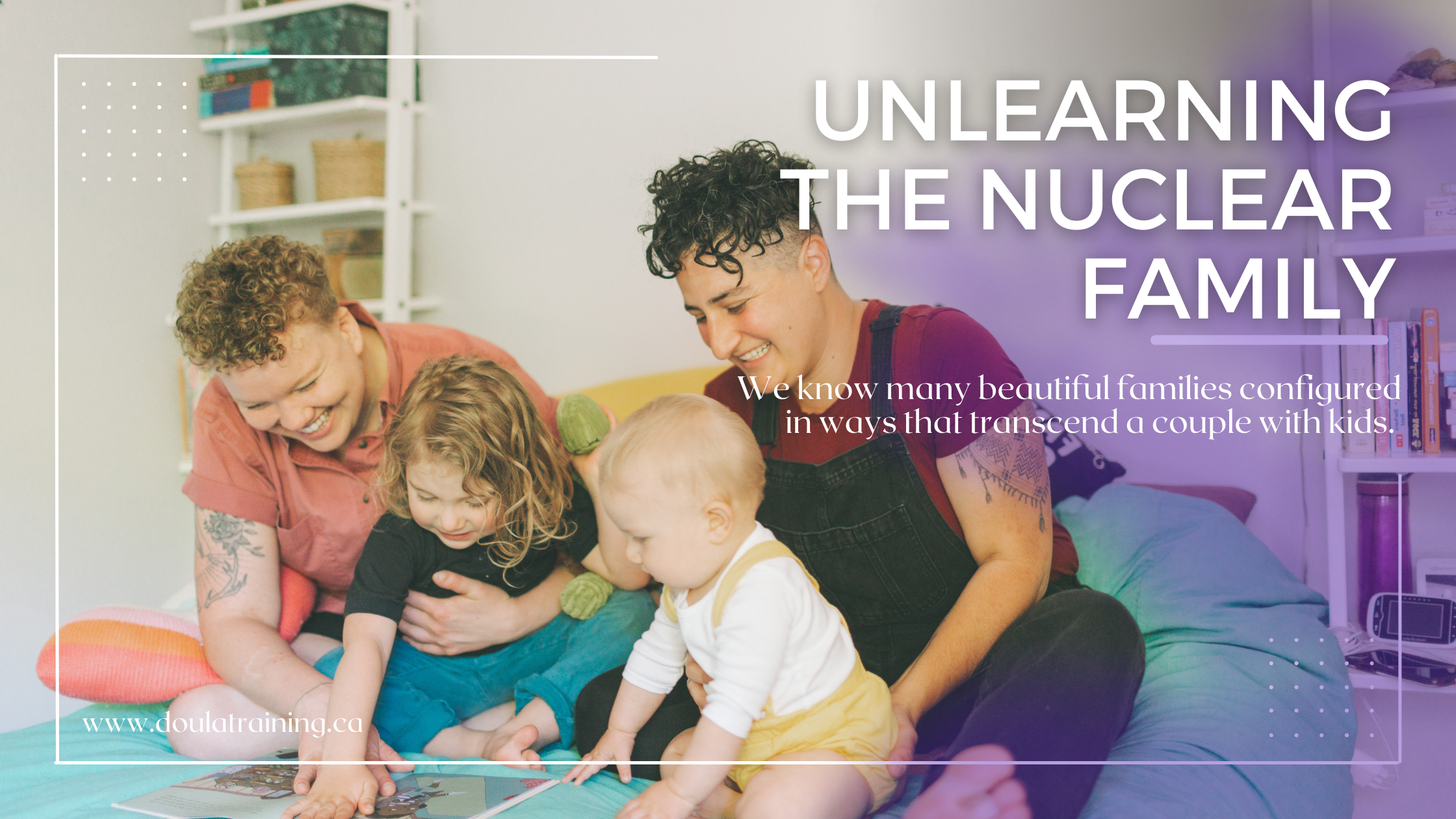
    We know many beautiful families configured in ways that transcend a couple with kids. We know quartets of a lesbian couple and a gay couple who have chosen to co-parent. We know gay and lesbian besties who have chosen to co-parent with their respective biological and chosen families behind them. We know lesbian couples with a known sperm donor who is deeply involved in their child’s life. There are triads or “thrupples” (a partnership involving 3 adults) who choose to raise families. This could look like a mom having a baby with each of her two male partners, or two women each having a baby with their male partner or any other number of ways of creating a family.

    The reality is that Queer and Trans Culture isn’t just about having a life partner who was assigned the same sex as you at birth. Our cultural norms are forged from a history where the most conventional, nuclear way that we could have a family was still socially unacceptable. Many of us and our queer elders were rejected by our biological families for being honest about who we are. As a result, our community has been resourceful and resilient in carving out new ways of defining “family” and building family units that allow us to be whole. We create our own villages that know who we are, where we’ve been, and where we’re going to support us while we child rear and do this thing called life.

    5 was a vital turning point for queer and trans families. It made the relationship to the child the focus of parental rights, rather than biology. The law also makes it possible for more than two people to be the legal parents of a child. This legal change was extremely important, but it’s only a fraction of the needed social change.

    We must unlearn the idea that “parent+parent+kid(s)=family”. There are infinite equations that can add up to a family. As professional support people, we can embrace the expectation that clients seeking our help could come in ones, twos, or more, reflecting any mix of gender identities. 

    We can also expect that folks living outside the parental binary are seeking our support specifically because they can expect that other parts of the health and social service systems don’t expect them, and might be hostile toward anything or anyone that challenges their expectations. We can create an unconditional blanket of compassion and support around all the beautiful shapes and sizes that families come in. That blanket is also a shield against fear and hate that preserves the sacredness of the parenting journey for all people.[/vc_column_text][/vc_column][/vc_row][vc_row][vc_column][mk_padding_divider][/vc_column][/vc_row][vc_row][vc_column][vc_column_text css=”.vc_custom_1686178152124{margin-bottom: 0px !important;}”]

    Keira Grant (she/her) Inclusion and Engagement Lead – Racialized Communities

    Keira brings a wealth of experience to the Online Community Moderator role. She is a Queer, Black woman with a twenty-year track record in Equity, Diversity, and Inclusion (EDI) education, projects, and community building initiatives.[/vc_column_text][/vc_column][/vc_row]

  • Why Representation Matters.

    [vc_row][vc_column][vc_single_image image=”502714″ img_size=”full” alignment=”center”][/vc_column][/vc_row][vc_row][vc_column][mk_padding_divider][/vc_column][/vc_row][vc_row][vc_column][vc_column_text css=”.vc_custom_1685976157863{margin-bottom: 0px !important;}”]As Pride month comes to a start, I decided to write a more personal piece for the Doula Canada blog. As many queer people know, the process of coming out isn’t linear nor a one time deal. Queer people often come out over and over, in every day interactions. We decide whether or not its safe to come out, whether or not it will have repercussions professionally, socially, and within our family circles. Pride comes with a lot of baggage. Working at a feminist vocational school, that celebrates diversity and inclusion, I know that writing this is a safe space. 

    You see, I’m freshly out. I’ve been “out” as pansexual for about five years, but being “conceptually queer” and “actively queer” feel very different. Not that pansexuals do not struggle, we do, but we have one of those “border” identities where we can experience privilege and oppression at the same time, i.e. “passing”. Being able to pansexual while being in opposite sex relationships had a sense of “safety” in it. I could identify as queer, but also feel accepted and included by following compulsory heterosexuality. 

    What is that you ask? Compulsory heterosexuality is the concept that society favors those who act in heterosexual ways. Our social norms favor heterosexuality, and it is assumed to be the default. You see this when someone asks you if you have a spouse of the opposite sex. When teachers can speak about their partners freely (as long as they are straight) and we assume things about strangers we do not know. Being conceptually queer, but passing as “actively straight” kept me safe. I didn’t have to have uncomfortable conversations, debate whether someone would be accepting of my partner, or wonder if it would be a deal breaker for a job. Until one day, passing didn’t work for me.

    I’m 28 years old from a rural area in Northeastern Ontario. I went to a Catholic school where bringing a partner of the same sex to prom was forbidden, and we were told our “lifestyles” were unnatural and against God. I came from an area where queer people were (visibly) few and far between, and if they were outed they were ostracized for being “predators” or other horrendous, homophobic things. At one point, I thought I was queer when I was about 14 years old. A school counselor told me that all girls feel that way at some point, and I believed her. As I grew up, I thought I was emotionally bankrupt to all my boyfriends, that perhaps I was asexual, or traumatized, and that one day I would marry a husband. Asexuality and trauma are valid, but for me, it was a mask that seemed “more appropriate or acceptable” than the thought that I may be attracted to women. I didn’t realize that most women don’t see finding a husband as a begrudging task on a to-do list. This was compounded by the “ball and chain” rhetoric of a heteronormative and often misogynist society. Dating, sex, and marriage is supposed to be disappointing if you are a woman with a man (we’re often told).  It was easier for me to believe I may be asexual or traumatized than to think I may one day marry a woman. This is when I realized, I may not be attracted to men at all. But I didn’t know what that would look like.

    Representation matters, because I had none. 

    I was 20 before I saw a lesbian in a professional role, that wasn’t actively trying to hide her identity from the institution she was employed from. She was my Women’s Studies 1000 professor, and I thought about how brave that was. I didn’t realize that queer women could be out in positions of power without punishment.

    I was 24 before I realized that you could be queer without ostracization in a bigger city. I was surrounded by queer friends who were living their joyful lives, loving their partners, and living (mostly) without harassment.

    I was 26 before I met my first queer couple with children. I was downtown Toronto and finally seeing lesbian and gay couples living loud and proud, and simple and boring just like any other couples. I had never seen pregnancy and childrearing in queer couples, and had always tied my dream of having kids with being in a heterosexual relationship. Representation changed this for me.

    How does this relate to doula work? Easy. If you’re a queer doula, you are actively showing the world that queer people belong in the doula space. If you’re creating inclusive advertising for trans and queer people, you are telling them you see them, and they belong in the reproductive health discussion. When you use a trans person’s pronouns, you are validating their experience and showing them you respect their identity. When you learn about surrogacy, IVF, and adoption support, you are creating more services for queer people to access.

    Representation matters because it shows queer youth, and queer adults that their experiences are normal, and can be expansive and joyful. It shows others the possibilities within being queer. It shows us our dreams can exist in a comphet society, and that we don’t have to give up a part of ourselves to be happy. So this pride, when you hear someone say “Why do they have to be so LOUD about it?” tell them its for every queer person who is forced to live quietly, and is silently listening.[/vc_column_text][/vc_column][/vc_row][vc_row][vc_column][vc_separator color=”violet”][/vc_column][/vc_row][vc_row][vc_column][vc_column_text css=”.vc_custom_1685976337654{margin-bottom: 0px !important;}”]

    Kayt (she/her) is an Anishnaabe kwe from Bonnechere Algonquin territory and the owner of Sweetgrass Solace Wholistic Support. Her post-secondary education includes a Bachelor of Social Work and Bachelor of the Arts in Indigenous Studies from Trent University (2021). She is also a certified hatha yoga teacher and a certifying birth and postpartum Doula.[/vc_column_text][/vc_column][/vc_row]

  • Using Doula Care as Community Aid: The Giving Equation

    Using Doula Care as Community Aid: The Giving Equation

    [vc_row][vc_column][vc_column_text css=”.vc_custom_1684151324317{margin-bottom: 0px !important;}”]As I’ve been going through our Truth and Reconciliation Action Plan, I’ve been continuously thinking about doula care and community aid, and how we can continue to decolonize our practices. As doula care becomes more “trendy” in current society, as it continues to dominate mostly higher-class spaces, how do we reflect on the roots of doula care, and stay true to community work? Of course, as doulas we do not feed ourselves and pay the bills off of warm and fuzzy feelings, but I think it is realistic to say most of us enter the field with a certain amount of passion and drive to create change in our communities. Whether that be being inspired by our own birth experience, or noticing how much of a difference our own doula made, most of us come to doula care for a deep reason.[/vc_column_text][/vc_column][/vc_row][vc_row][vc_column][vc_column_text css=”.vc_custom_1684151342874{margin-bottom: 0px !important;}”]However you identify, birth work has the ability to bring folks together. The birth and the postpartum periods are intimate and vulnerable. Individuals from marginalized communities may wish to hire someone with the same identity or lived experience as them. As someone from a certain background you may possess a set of skills, knowledge or spiritual/cultural teachings that someone from an outside identity may not. For example, a Muslim family may choose to hire a Muslim doula who may better understand their traditional customs and practices surrounding birth. An Indigenous family may choose an Indigenous doula who understands and celebrates their practices and understands the risk of violence within the medical system.[/vc_column_text][/vc_column][/vc_row][vc_row][vc_column][vc_column_text css=”.vc_custom_1684151427232{margin-bottom: 0px !important;}”]

    Below are some tips on using your practice and voice as a doula to help your community:

    1. Marry your interests

    An easy equation for finding what population you want to serve is this: identifier + lived experience + passions and skills.

    Between your lived experiences and passions/interests and skill, lays your intended community. For example, as an Indigenous mental health practitioner who grew up low-income, I chose to narrow my focus on low-income families and trauma survivors. Think about the spaces you frequent, the groups you are a part of, your professional training and hobbies.


    Identifier: Indigenous, Queer

    Lived experience: Poverty

    Skill: Social work background

    Passion: Trauma

               _______________________________

    Target communities:

    Indigenous families

    Queer Families

    Low Income Families

    Trauma Survivors


    2. What can you afford to give?

    Whether that is your time, or money, or expertise. Some doulas choose to dedicate acouple of births per year pro-bono or sliding scale. Perhaps, you decide to attend protests and events as a community member that are relevant to your population. You may have resources you don’t mind sharing.or books to loan out. Be creative!


    3. Advocacy

    What issues are impacting your community? How can you use your voice in a way that helps others? Perhaps you can assist in social movements regarding reproductive health.How do you use your social media. What current issues are really important to you?

    [/vc_column_text][/vc_column][/vc_row][vc_row][vc_column][vc_column_text css=”.vc_custom_1684151541045{margin-bottom: 0px !important;}”]

    These are just a few of the ways that you can take your profession, and use it for social change. What other ways can you make waves?


    Here are some exploratory journal prompts for you:

    • Why did I choose to become a doula?

    • What social issues am I passionate about?

    • What can I afford to give?

    [/vc_column_text][/vc_column][/vc_row][vc_row][vc_column][vc_column_text css=”.vc_custom_1684154527320{margin-bottom: 0px !important;}”]-Kayt Ward, EDI Co-lead, BSW[/vc_column_text][/vc_column][/vc_row]

  • Doula Canada Presents: Anti-O Bingo

    Doula Canada Presents: Anti-O Bingo

    [vc_row][vc_column][vc_column_text css=”.vc_custom_1681230324378{margin-bottom: 0px !important;}”]

    Aaniin Doulas!

    [/vc_column_text][vc_empty_space][vc_column_text css=”.vc_custom_1681233848048{margin-bottom: 0px !important;}”]

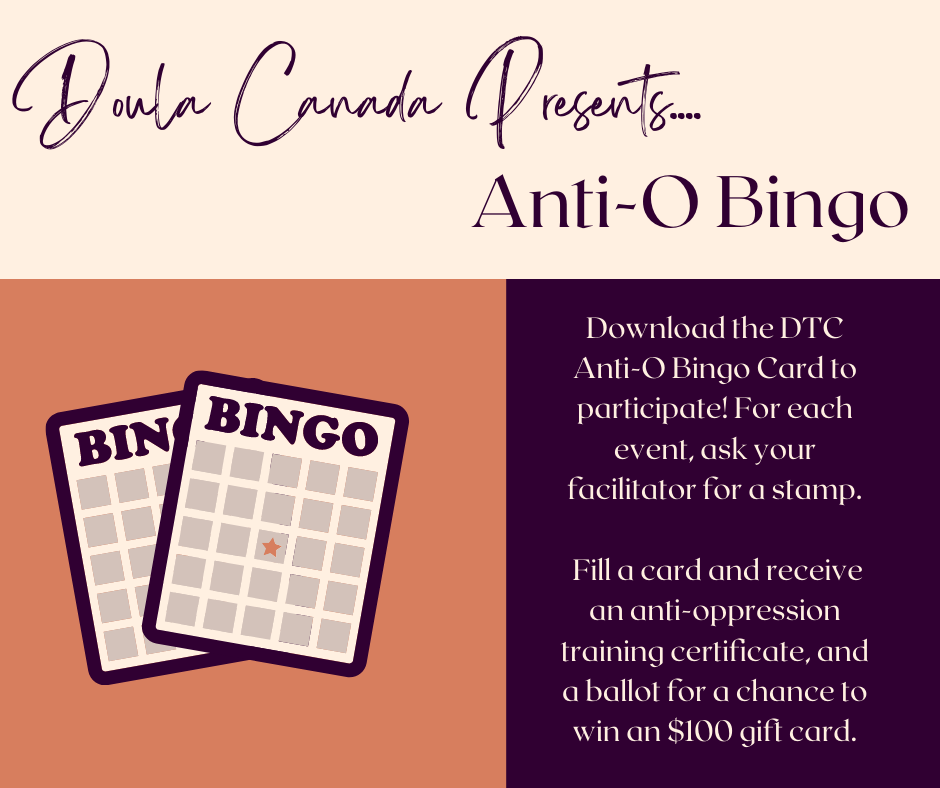
    This month we are introducing a new EDI initiative, and we want our students and alumni to play! Introducing…. Anti-O Bingo!
    You’ve given your input, and we’re listening. Through our Truth and Reconciliation Action Plan, and our EDI surveys, we have identified anti-oppression and cultural training as one of the many areas Doula Canada doulas are interested in pursuing.

    [/vc_column_text][vc_empty_space][vc_column_text css=”.vc_custom_1681230266671{margin-bottom: 0px !important;}”]

    How to play:
    1. Click HERE to download your free Anti-O Bingo Card
    2. Attend an event from each category
    3. At each event, ask your facilitator for your custom .jpeg stamp. Paste it into a doc! (Remember to save it!). If you are attending a livestream (Just Birth, Fireside Chat, etc), please submit a paragraph on what you learned to kayt@stefanie-techops.wisdmlabs.net
    4. When you have all 8 stamps, please submit your doc to kayt@stefanie-techops.wisdmlabs.net for your Anti-Oppression in Doula Care 101 Certificate and a ballot to win an $100 Etsy Gift Card.

    [/vc_column_text][vc_empty_space][vc_column_text css=”.vc_custom_1681230291218{margin-bottom: 0px !important;}”]

    You have until December 31, 2023. Good Luck!

    [/vc_column_text][vc_empty_space][vc_column_text css=”.vc_custom_1681230336832{margin-bottom: 0px !important;}”]

    Chi Miigwetch! Nia:wen!
    Kayt Ward and Keira Grant, EDI Leads

    [/vc_column_text][vc_empty_space][/vc_column][/vc_row][vc_row][vc_column][vc_single_image image=”494571″ img_size=”full”][/vc_column][/vc_row][vc_row][vc_column][mk_button corner_style=”rounded” size=”large” url=”https://stefanie-techops.wisdmlabs.net/wp-content/uploads/2023/04/edi-bingo.pdf” align=”center”]Get Your Anti-O Bingo Card here![/mk_button][/vc_column][/vc_row]

  • Why Black Futures Begin with Birth

    Why Black Futures Begin with Birth

    [vc_row][vc_column][vc_column_text css=”.vc_custom_1676056467901{margin-bottom: 0px !important;}”]

    Why Black Futures Begin with Birth

    Written by Keira Grant  – DTC EDI Lead for Racialized Communities

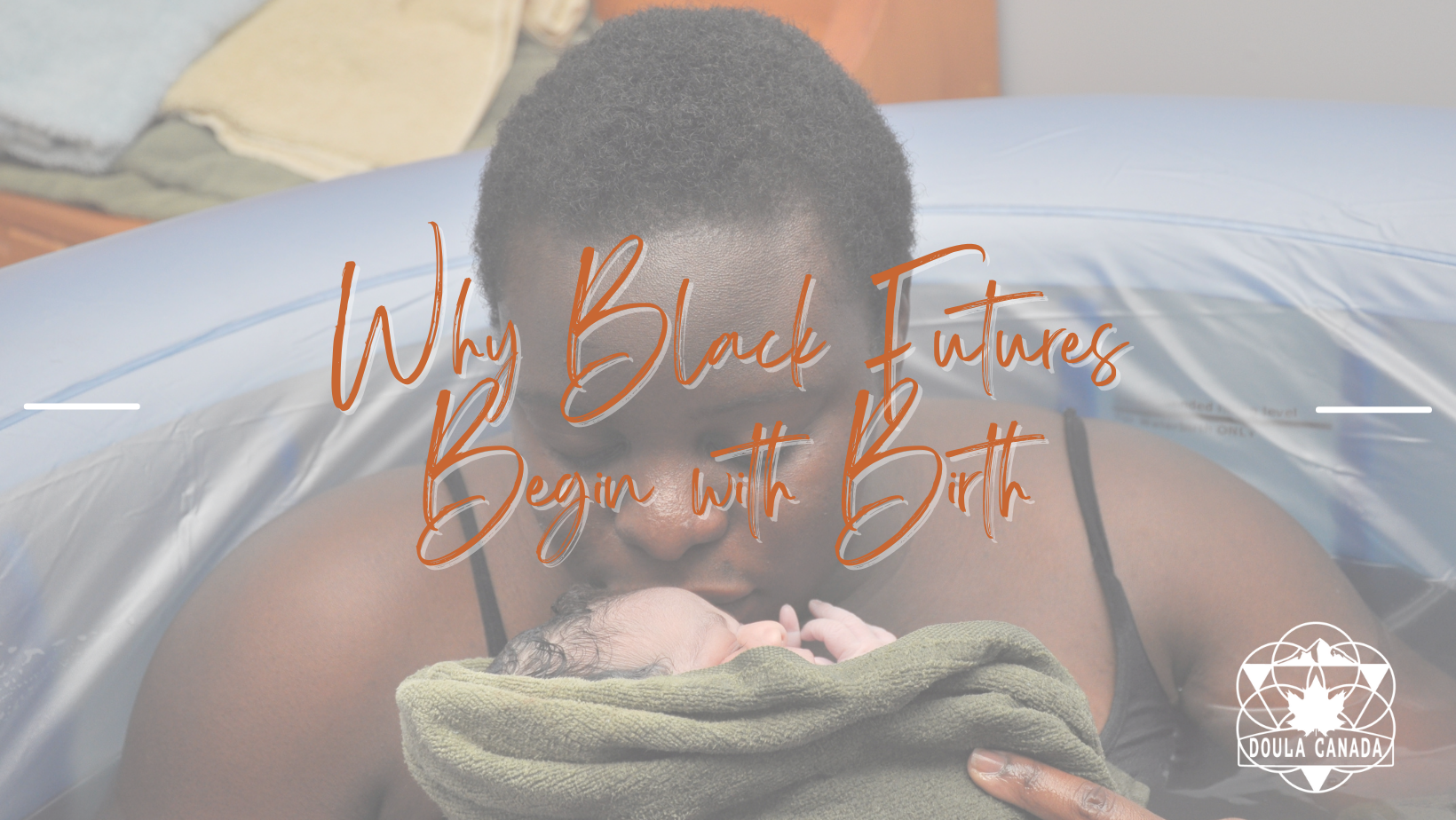
    February is widely known as Black History Month. This term has rubbed me the wrong way since I was a kid, but it took me a while to put my finger on why. The reference to “history” is full of loaded assumptions that are highly convenient to colorblind multiculturalism. It suggests that racism toward Black people is something that happened a long time ago, maybe in a faraway place. Then slavery ended and then there was Black excellence.

    Of course, there have always been excellent Black people, but that’s not really how the story goes. The beliefs that made slavery possible for centuries are part of the fabric of society. Even when we are excellent by eurocentric, capitalistic standards, it could still go the way it went for Tyre Nichols.

    The violence that brutally ended the life of Tyre and so many others like him flows through all social institutions, not just policing. In countries such as the United States and the United Kingdom where race-based health data is collected, these data show that Black birthers are anywhere from 3 to 4 times more likely to die in childbirth than their white counterparts. Our babies are also at a significantly increased risk of death. This holds true, independent of education and socioeconomic status. The birth stories of celebrities like Beyoncé Knowles, Serena Williams, and Tatiana Ali, (whose story we’ll be discussing at March’s Equity Watch Party), bring these statistics to life.

    At this time, many players in the Canadian healthcare system are calling for the collection of disaggregated race-based data. In the US, the collection of these data, and the resultant evidence of disparities has led to increased funding for programs that improve Black maternal health, including a proliferation of programs for accessing a Black doula. It has also supported requirements that health professionals receive training in implicit bias.

    It’s been widely reported in the news that Tyre Nichols called out for his mom during the brutal attack that ended his life. Every Black person who dies as a result of structural violence is someone’s baby. When systemic disrespect and harm toward Black birthers and babies is normalized, rationalized, and justified it is the start of a pattern that impacts Black people across the lifespan. Emerging research is actually demonstrating that racial stress accelerates the aging process of Black women.

    Creating a circle of love and support around Black birthers and their babies that is honest about what we are up against, and that celebrates our lives and well-being can have a profound impact on how someone’s life starts. It can affect how their life continues by showing them and their families that it is possible to create spaces where Black people are affirmed and nourished.

    We talk about equity, diversity, and inclusion in this work all the time. During February, we have additional opportunities for our members to learn and engage in dialog about anti-Black racism and racial health equity in perinatal care. We are using the language Black Futures Month, “a visionary, forward-looking spin on celebrations of Blackness in February”.

    [/vc_column_text][/vc_column][/vc_row]

  • Advocacy at Doula Canada

    Advocacy at Doula Canada

    [vc_row][vc_column][vc_column_text css=”.vc_custom_1669384798061{margin-bottom: 0px !important;}”]Doulas support birthers, babies, and family members during an intimate and emotionally charged experience that often involves many medical twists and turns along the way. For many doula clients, pregnancy and childbirth are among the most complicated experiences with our healthcare system they will have ever had to navigate. We know that birthers need to feel in control of what happens to their bodies and to be making informed choices about their care to create a positive experience and avoid trauma. 

    Doulas can change a person’s healthcare experience for the better by supporting their bodily autonomy and informed decision-making. Additionally, we are well placed to notice systemic issues that impact our clients again and again, and to use our knowledge to encourage and support changes.

    Learning to engage in this type of advocacy within the scope of the doula’s role, so that our efforts are helpful, is an important aspect of our learning and professional development. To support our students and alumni, Doula Canada has developed an advocacy framework that defines advocacy in the context of doula practice and describes approaches to individual advocacy that are aligned with respect for client autonomy. 

    Our framework identifies three categories of advocacy that doulas engage in: systemic advocacy, self-advocacy promotion, and individual advocacy. 

    Systemic advocacy is any effort to change, remove, or add a policy or process that affects the lives of birthers, families, babies, or doulas. Examples include lobbying your elected federal representative to change the birth evacuation policy or amplifying social media campaigns that raise awareness regarding perinatal mental illness.

    While we don’t usually think of it as such, our work with clients to support them to know the evidence regarding their perinatal circumstances, and ask the right questions of their healthcare providers is a form of advocacy. We encourage them to use their voice and make their conversations more effective because they are armed with information.

    Sometimes, especially in the birth room, it might be necessary to advocate for the client in more direct ways. It is important that this individual advocacy does not manifest as speaking for or over the client, or in a manner that could worsen their care or medical situation.

    A 2020 paper by S.S. Yam based on interviews with doulas identified three types of tactics that doulas use to advocate for their clients during labour and delivery. She calls these “soft-advocacy” techniques because they differ from what we usually think of as advocacy. Staff and instructors at Doula Canada agreed they used these strategies and had lots of guidance to offer on exactly how to use them. Their guidance was used to develop the advocacy framework. 

    The three tactics identified by Yam are 1) creating deliberative space, 2) cultural and knowledge brokering, and 3) physical touch and spatial maneuvers. 

    Creating deliberative space refers to strategies that give the client more time to ask questions and make decisions. One example of how doulas do this is by noticing that care that deviates from their preferences is about to happen and bringing it to the client’s attention, prompting them to ask about the intervention that is about to happen.

    Cultural and knowledge brokering refer to the tactics doulas use to make sure the client understands medical jargon or cultural norms. This could involve paying close attention to the information provided by the medical team, observing how well this is understood by the client, and repeating the information in language that the client uses and understands.

    Physical touch and spatial maneuvering refers to the ways we use our bodies and physical contact with the client to advocate for their needs. Examples include using our bodies to conceal the client from view, modeling consent by asking permission each time we touch the client, and using our presence to back up the client during interactions. 

    The complete framework is linked below. It offers more detail on the three types of advocacy and the soft-advocacy strategies. It illustrates these concepts using case studies based on staff and instructor experiences. 

    In 2023, Doula Canada will continue its work to support advocacy among its members by developing an advocacy toolkit from the framework and launching an advocacy working group for students and alumni. [/vc_column_text][/vc_column][/vc_row][vc_row][vc_column][mk_button corner_style=”rounded” size=”large” url=”https://stefanie-techops.wisdmlabs.net/wp-content/uploads/2022/11/advocacy-framework-paper.pdf” align=”center”]Click here to view the full Advocacy Framework document[/mk_button][/vc_column][/vc_row]

  • Doula Canada’s TRC Action Plan Draft

    Doula Canada’s TRC Action Plan Draft

    [vc_row][vc_column][vc_column_text css=”.vc_custom_1663885967069{margin-bottom: 0px !important;}”]

    Aaniin! Boozhoo!

    As most of you know, the 30th of September each year is National Day of Truth and Reconciliation or Orange Shirt Day. The day is used every year to commemorate survivors of residential schools, as well as push for change in the form of allyship and reconciliation between settlers and Indigenous Peoples. But- reconciliation doesn’t begin and end on September 30th. It is something that is a continuous process, every day, for people inhabiting Turtle Island.

    This month, Doula Canada is releasing our Truth and Reconciliation Action Plan Draft for students and alumni to check out! Based on the Truth and Reconciliation Commission of Canada’s 94 Calls to Action, our reconciliation plan for 2023 reflects the goals outlined in the recommendations by the commission. You can see the action plan here below.

    What does this mean? It means that these four recommendations are what we are working toward in 2023. As we continue our journeys as a vocational school, we will continue to evaluate how we can incorporate more of these goals into our curriculum, programming, and overall community at Doula Canada.

    It doesn’t end here. We want to hear from you! An anonymous feedback form for both Indigenous and Non-Indigenous members is available using This Link. (https://docs.google.com/forms/d/e/1FAIpQLSczDwoD1ZmkYI501_8Xv8JaeOkhkEEsQq_rM4K_AywfuUu8Jg/viewform?usp=sf_link)

    There will also be a two-hour Indigenous-specific focus group in November led by Inclusion and Engagement Lead for Indigenous Peoples, Kayt Ward. Honorariums will be provided to participants. Please stay tuned for dates and times or email Kayt at kayt@stefanie-techops.wisdmlabs.net if you’re interested in participating.


    September 30th- How are you reflecting? Staff at Doula Canada will be participating in various learning experiences throughout the day, and we recommend students do the same. Don’t know where to start? Follow our social media to register for events we will be promoting by external organizations, come to one of the following events, or try a journal prompt.

    • Indigenous members pop up Bannock and Tea circle. Topic: Peer Support and Grief. September 30th, from 6-7 pm EST on Zoom.
    • “We Were Children” Film Night and Settler Learning Circle. September 30th from 7-8 pm EST on Zoom.

    Journal Prompts:

    What can we do as educators and birth workers to decolonize and deconstruct power systems in Canada? How can we dismantle oppression, and create a safe and equitable space for all?

    What is my relationship with the land I reside on. Whose land am I standing on?

    How can I participate in decolonization and the Landback movement?

    How does settler-colonialism impact my life?

    Chi Miigwetch,
    Kayt Ward, Inclusion and Engagement Lead for Indigenous Peoples[/vc_column_text][/vc_column][/vc_row][vc_row][vc_column][vc_single_image image=”461820″ img_size=”full” alignment=”center”][/vc_column][/vc_row][vc_row][vc_column][vc_single_image image=”461821″ img_size=”full” alignment=”center”][/vc_column][/vc_row][vc_row][vc_column][vc_single_image image=”461822″ img_size=”full” alignment=”center”][/vc_column][/vc_row][vc_row][vc_column][vc_single_image image=”461823″ img_size=”full” alignment=”center”][/vc_column][/vc_row]

  • Recognizing Asian Heritage Month and Jewish Heritage Month

    Recognizing Asian Heritage Month and Jewish Heritage Month

    [vc_row][vc_column][vc_column_text css=”.vc_custom_1653215730289{margin-bottom: 0px !important;}”]May is Asian Heritage Month and Jewish Heritage Month. It’s a great opportunity to reflect on what we mean by “heritage” regarding the history of these two communities in “multicultural” Canada, and what this means for creating cultural safety in birth work.

    I’ve lived in the GTA my whole life. Here, a “heritage festival” typically amounts to a street party with food, live music and dance, and other culture-specific entertainment. I am actually a great lover of a good street fair. The food and performances are usually lit. I have also learned a lot about Jewish and Asian history and culture at events like the Ashkenaz Music Festival and Taste of Asia. I also understand that many communities are not fortunate enough to have this level of exposure to culture and diversity. But these cultural displays are not only far from telling the whole story of the “heritage” of Asian and Jewish people in Canada, but they also contribute to “false peace” – the illusion that multiculturalism is working out, that we are all getting along, and that we are all equal.

    In truth, there is anti-Asian racism and anti-Semitism at the core of Canada’s heritage. Those of us who remember “Heritage Minutes” from the 1980s and 90s may know about the lethal exploitation of Chinese migrant workers that occurred in the 19th century to support the construction of the trans-Canada railroad. There are many other examples, including the head tax, and internment camps during WWII

    Anti-Semitism is equally a part of the fabric of Canada’s history. Wide-spread belief in a Jewish conspiracy to achieve global economic domination that originated in Europe and spread to North America made Jewish Canadians an easy scapegoat during the great depression. Additionally, to limit the economic advancement of Jewish immigrants in the early 20th century, Canadian universities implemented quotas that restricted the number of Jewish applicants who could be admitted to the school.

    It’s easy to hear these stories and think “this has nothing to do with me”, “this is ancient history”, “I didn’t do these things”, and “let’s focus on the positive and how far we’ve come”. While these sentiments are understandable, the reality is that the present arises from the past. These uglier parts of our heritage are directly related to more recent attacks on synagogues and the hate crimes experienced by Asian Canadians during the pandemic. 

    Moreover, this heritage underpins the modern assumptions that manifest more subtly as microaggressions that affect the day-to-day navigation of society and impact the long-term mental and physical health of equity-seeking people. Some of these stereotypes may seem harmless or even positive. But in reality, they fuel the construction of whiteness as the social norm, put people in boxes, and create false impressions regarding people’s realities.

    As birth workers, we can create cultural safety regarding the beautiful and the traumatic aspects of each client’s heritage. We can create space for them to share whether they have any cultural or religious traditions that they would like to honour. And we can also be mindful of things like how common stereotypes about Asian women may influence provider perceptions of client autonomy. Or how the intergenerational trauma of Holocaust survivors may impact pain management. There are a number of ways that our identities can impact our pregnancy and parenting journey. Shining a light on the good, the bad, and the ugly of our heritage sets us up to ask the right questions and facilitate the needed conversations with all of our clients.[/vc_column_text][/vc_column][/vc_row]